IOC mulls reform in selection process for future Olympic hosts


MILAN: The International Olympic Committee (IOC) is considering reforming its procedure for awarding future Games to restore “transparency” and establish a clearer timetable, as the contest looms as to who hosts the 2036 Summer Olympics.
The 2036 race is considered wide open and is expected to feature bids from India and Qatar, with Saudi Arabia, South Korea, South Africa, Turkey and Chile among other interested parties.
“While there is no desire to return to the costly pre-2019 bidding process, the current election process requires refinement,” former Croatian president Kolinda Grabar-Kitarovic, now an IOC member, told delegates on Wednesday during the IOC Session in Milan ahead of the 2026 Winter Olympics.
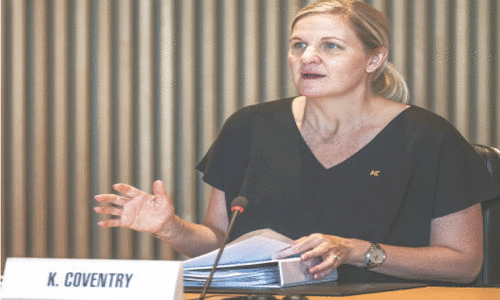
Grabar-Kitarovic, who heads a working group on the designation of Olympic hosts set up by IOC president Kirsty Coventry, said she believed “structured timelines, increased transparency and more meaningful participation by IOC members” were required.
Since 2019 — when Coventry’s predecessor Thomas Bach was president — the IOC has radically changed the way it chooses Games organisers, with the aim of stemming the lack of candidates, reducing costs and avoiding inflicting public humiliation on unsuccessful bidders.
Gone are the suspense-filled elections, seven years before the event, in which the lucky winner was drawn from an envelope during a ceremony broadcast around the world, after costly campaigns to promote bids.
Negotiations are now confidential until the designation of a “preferred host”, which is selected behind closed doors by the IOC’s Executive Board and approved at the end of the process by the roughly 100 IOC members meeting in their Session.
Grabar-Kitarovic said her working group was proposing introducing a “transitional stage”.
It would “allow shortlisting of a limited number of interested parties with advanced projects for deeper evaluation”.
That evaluation “should be based on transparent criteria published in advance”, she added.
Grabar-Kitarovic suggested such criteria could include “the importance of venue master plans, clarity on the sports programme, financial guarantees, and the added value of prior experience in hosting multi-sport events”.
The current procedure for selecting hosts has led to extremes, ranging from awarding the 2032 Olympics to Brisbane 11 years in advance to granting the 2030 Winter Games to the French Alps less than six years before the event, while the venue map and sports programme still needed to be finalized, along with the detailed budget.
Published in Dawn, February 5th, 2026