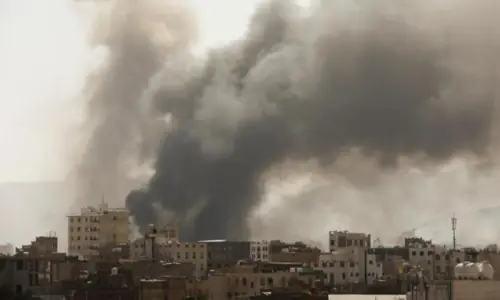
FOLLOWING last week’s terrorist attacks in Balochistan, the province’s volatile security situation has come under greater scrutiny in both houses of parliament. While resolutions condemning the terrorist atrocities have been adopted in the Senate and National Assembly, many lawmakers, particularly those in the opposition, have pointed out that greater debate is needed to address the root causes of the violence. In contrast, treasury politicians have rejected the idea of socioeconomic issues fuelling the long-running wave of separatist terrorism in the province. For example, Defence Minister Khawaja Asif criticised the narrative of disparity in the NA, saying this was being exploited by banned groups such as the BLA. He also rattled off figures comparing the growth in the number of health and education facilities in the province from independence to date. Prime ministerial adviser Rana Sanaullah expressed similar feelings in the Senate, saying “no one is angry in Balochistan; there is no issue of rights”. However, NA opposition leader Mehmood Achakzai, who hails from Balochistan, asserted that the “unjust distribution of resources” in the province had fuelled deprivation, which is driving terrorism.
While no cause can justify the murder of innocent people, the state must probe what truly ails Balochistan. The actions of terrorist groups are horrific, while there is also strong evidence that hostile foreign actors are trying to destabilise the province. Hence, the kinetic element is essential to defeat terrorism. But the state must confront other facts too: despite boasting immense natural and mineral wealth, Balochistan’s socioeconomic indicators are appalling. And while officials may dismiss observations by local activists and politicians as ‘propaganda’, what would they say about the World Bank’s assessment in a 2024 report, which observed that Balochistan’s human capital indicators are “amongst the lowest in the world” and that nearly half of under-fives in the province are stunted, while 58pc of children are not in school. While clamping down on terrorism, the state must also confront these truths. These figures will not change overnight, but the state must address the Balochistan issue holistically, looking at the long term. In that regard, the provincial chief minister’s idea of rounding up family members of suspected terrorists is a bad idea, akin to collective punishment as practised in the colonial era.
Published in Dawn, February 4th, 2026