92 terrorists killed as attacks repulsed in Balochistan


• ISPR says 15 security men, 18 civilians martyred
• Attacks reported in Quetta, dozen other towns
• Internet suspended in several districts
• President, PM praise forces
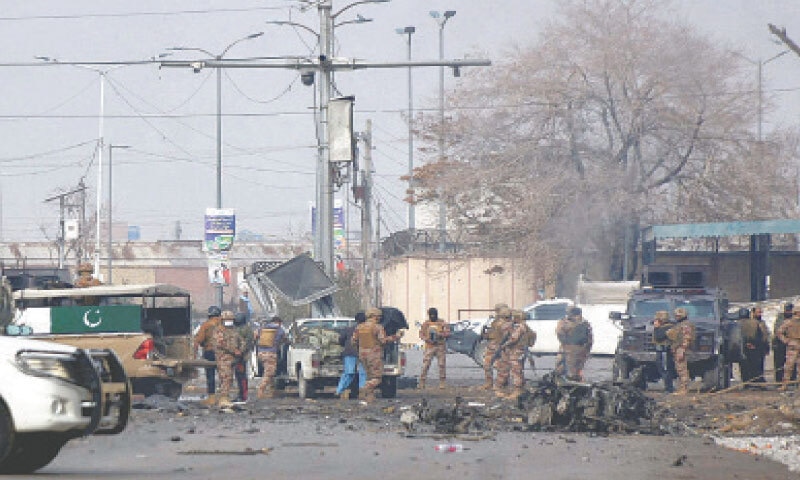
QUETTA: As many as 92 terrorists were killed on Saturday as security forces repulsed coordinated attacks by members of banned organisations in parts of the provincial capital and around a dozen other cities and towns across Balochistan, the military’s media wing said.
In a statement, Inter-Services Public Relations (ISPR) said 15 security personnel were martyred while repulsing the attacks, while 18 civilians also lost their lives.
It said that terrorists belonging to Indian-sponsored Fitna al Hindustan “attempted to disturb peace of Balochistan” by conducting multiple terrorist activities around Quetta, Mastung, Nushki, Dalbandin, Kharan, Panjgur, Tump, Gwadar and Pasni.
The state has designated Balochistan-based terrorist groups as Fitna al-Hindustan to highlight India’s alleged role in terrorism and destabilisation across Pakistan.
The ISPR said that at the “behest of their foreign masters, these cowardly acts of terrorism were aimed at disrupting the lives of the local populace and the development of Balochistan”.
It said terrorists targeted civilians in Gwadar and Kharan, including women, children, the elderly and labourers, resulting in the deaths of 18 people.
“Security forces and law enforcement agencies, being fully alert, immediately responded and successfully thwarted the evil design of terrorists, displaying unwavering courage and professional excellence,” it added.
It said that troops, after an “intense and daring clearance operation”, killed 92 terrorists, including three suicide bombers.
“Intelligence reports have unequivocally confirmed that the attacks were orchestrated and directed by terrorist ring leaders operating from outside Pakistan, who were in direct communication with the terrorists throughout the incident,” the ISPR said.
Noting that 41 terrorists were killed in Panjgur and Harnai on Friday, the ISPR said the total number of slain terrorists in “ongoing operations” in Balochistan had reached 133.
Police stations, banks targeted
According to reports, the assailants targeted police stations in Quetta’s Sariab area, torched records and killed officers who resisted the attacks. They also raided banks in the Hazarganji area and opened indiscriminate fire before dispersing into different localities of Sariab.
In Kharan, armed men attacked the residence of the Mullazai Qaumi Etihad chairman, killing him and his six security guards. Senior police officer Abdul Baqi said the attackers fled the area after the assault.
In the Tump area of Kech district, armed men shot dead former tehsildar Abid after he resisted an attempted kidnapping.
Sources said armed men also attacked Mastung, burning the police station and breaking into the district jail, freeing 30 prisoners. They also targeted banks and government institutions.
Similar attacks occurred in Kalat, where terrorists attacked banks and police stations, injuring three police personnel and setting banks ablaze. Government offices were also attacked.
The provincial health department said an emergency was declared in all government hospitals across Balochistan. It said that operating theatres at Quetta Trauma Centre and Civil Hospital were put on alert, and additional doctors were deployed.
Authorities closed highways linking Balochistan to Karachi and other areas, stranding vehicles, including passenger buses, on the Noshki-Taftan highway.
Pakistan Railway suspended train services to Peshawar, Karachi and Chaman. Internet, WhatsApp and phone data services were suspended in Noshki, Mastung, Sibi, Chaman, and parts of Quetta.
‘Desperate move’
Information Minister Attaullah Tarar described the attacks as a “desperate move” and said security forces remained on alert.
“Our security forces, personnel and officers have fought bravely. They were alert at all sites and fully prepared,” he told Geo News in an interview.
He said that terrorists of the proscribed Balochistan Liberation Army had killed family members of Baloch labourers from Khuzdar and Gwadar.
He said aerial surveillance and ground operations were continuing, adding that the prime minister was being kept informed. “The prime minister condemned the attack and reaffirmed that we will not rest until the last terrorist is eliminated from the country,” Mr Tarar said.
Defence Minister Khawaja Asif said the attacks were terrorism being run under foreign patronage and not a struggle for rights.
“These elements neither tolerate development nor peace. That is why they target labourers, travellers and ordinary citizens, want to destroy development projects and employment opportunities, and conspire against projects like the China-Pakistan Economic Corridor,” he said in a post on X.
He said the terrorist groups recruited youth through social media and generated funds through extortion, smuggling and other criminal networks.
Explosives found in Nasirabad
Separately, police said explosive material was found on a railway track in Nasirabad district.
“An anti-tank mine and explosive material were found on the railway line near Rabi Pul,” said a statement issued by Nasirabad SSP Asadullah Nasir.
He said an improvised explosive device was neutralised after timely action by police, the Frontier Corps and the Special Branch.
The recovered items included half a kilogram of explosives, petrol and an iron rod, the statement said, adding that the material was handed over to the CTD for investigation.
Railway tracks have been targeted repeatedly in recent months. Most recently, a blast on Monday night derailed four bogies of the Quetta-bound Jaffar Express travelling from Peshawar and damaged the track.
The Jaffar Express had also escaped attacks in Nasirabad in October and November last year. Similar attempts also occurred during the two months in Kachhi and Sindh’s Shikarpur district.
Leaders condemn attacks
President Asif Ali Zardari commended the security forces and law enforcement agencies for foiling “infiltration attempts” at multiple locations and paid tribute to personnel and civilians killed in the violence.
“Our commitment is not to make any compromise on Balochistan’s peace, civilians’ protection and national unity,” Mr Zardari affirmed.
He asserted that the state would continue its operations against “enemy elements operating under external backing and their facilitators with full force and unity”.
Prime Minister Shehbaz Sharif also praised the security forces for foiling malicious attempts by Fitna al-Hindustan to disrupt peace in Balochistan, state-run APP reported.
The premier professional competence and bravery of the security forces for thwarting “coordinated attacks at 12 locations across Quetta, Noshki, Dalbandin, Pasni and Gwadar”.
“The entire nation, including myself, is proud of its martyrs,” the prime minister said, adding that the officers and personnel of the security forces were performing their duties with exemplary courage and selflessness.
Balochistan Planning Minister Mir Zahoor Ahmed Buledi strongly condemned the “damage to public properties and handful of terrorists terrorising citizens”.
“Balochistan will not be held hostage by these perpetrators of violence. With public support, LEAs (law enforcement agencies) have foiled terrorist designs,” he said on X.
The British High Commission also condemned the attacks. “Our thoughts are with the families of those who lost their lives and all those affected. We stand with Pakistan in rejecting terrorism and in our shared commitment to peace and security,” it said.
Rise in terrorism
The proscribed Balochistan Liberation Army has carried out frequent attacks in Balochistan, often targeting security forces and law enforcement agencies. In August 2025, the United States designated the BLA and its Majeed Brigade as foreign terrorist organisations.
Pakistan saw an escalation in terrorist violence in 2025, with terrorist attacks rising by 34 per cent and terrorism-related fatalities increasing by 21pc year on year, according to data released by the Islamabad-based Pak Institute for Peace Studies. The report put the total number of attacks during the year at 699.
Behram Baloch in Gwadar and Abdul Wahid Shahwani in Khuzdar also contributed to this report
Published in Dawn, February 1st, 2026