Local govts continue to be neglected despite crucial role in strengthening grassroots politics: Khawaja Asif
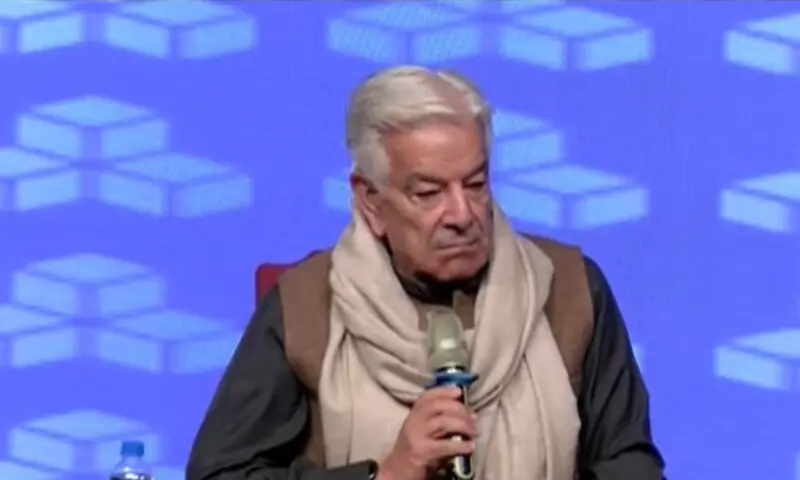

LAHORE: Defence Minister Khawaja Asif on Saturday stated that despite their role in strengthening grassroots politics, local governments continued to be neglected by political parties, which had ultimately weakened civilian rule.
The defence minister made the remarks while addressing a panel session titled “Devolution for Revolution” at ThinkFest, a political and literary festival.
Also present alongside the minister were Lahore University of Management Sciences’ (LUMS) Vice Chancellor Ali Cheema, former State Bank governor Dr Ishrat Hussain and former MPA Mary James Gill.
In his remarks, Asif said that three military rulers — Ayub Khan, Ziaul Haq and Pervez Musharraf — had remained in power longer than any civilian government largely because they introduced local government systems and drew political strength from them.
He admitted that the failure to institutionalise local bodies was “a political failure on our part”.
He noted that local government elections, whenever held, had historically been far less controversial than national polls.
“Yet we have continued to avoid them,” he regretted.
Asif recalled that local bodies were included in the Charter of Democracy signed by the PPP and the PML-N in 2006, but the provision failed to find adequate space in the 18th Constitutional Amendment even though most other agreed reforms were incorporated.
He added that the resistance to empowering the grassroots tier mainly came from the bureaucracy, which feared losing authority to elected representatives.
Expanding on the discussion, Cheema highlighted the administrative and service delivery dimensions of local governments.
While Asif focused on their political and democratic value, Cheema said their real strength lied in defining the state’s delivery system.
Citing international examples, he said the United Kingdom spent nearly 60 per cent of its development funds through local governments, while the United States allocated around 40 per cent.
“This is how they achieved the so-called municipal revolution,” he said.
Cheema said that in developed countries, local governments provided essential services such as clean water, sanitation, health facilities and civic infrastructure, while also collecting taxes and strengthening citizens’ sense of ownership.
“In Pakistan, unfortunately, this institutional infrastructure was never built,” Cheema said.
“When the system is missing, the sense of citizenship also remains weak,” he said.
The discussion then shifted to constitutional and fiscal reforms, with Dr Hussain pointing out that although the 18th Amendment clearly defined the roles of federal and provincial governments, it failed to properly outline the functions and powers of local governance.
“This ambiguity continues to create political and administrative friction,” he said, adding that the Amendment should have established a provincial finance commission to directly channel funds to underdeveloped areas within provinces.
Strong local governments, he argued, would not only improve development efficiency but could also “generate their own revenue by improving tax collection and identifying new income sources”.
Dr Hussain pointed out that if institutions such as the Lahore Development Authority, the Water and Sanitation Agency and other civic bodies were placed under the authority of an elected mayor, municipal administrations would become financially stronger and self-sustaining.
Advising political parties to embrace rather than compete with local governments, Dr Hussain said empowering the grassroots tier would ultimately strengthen democratic governance and benefit mainstream politics.
Meanwhile, Gill stated that local bodies gave identity and dignity to people at the grassroots level.
The defence minister has previously emphasised that local governments need to be empowered, stating earlier this week that the “dispersal of power actually multiplies power” and “concentration of power diminishes it”.
“Empowering local governments means taking the government to the common man’s doorstep,” he said in a post on X.
The defence minister contended that when a local government system becomes functional, “people will not be dependent on bureaucracy and will be able to elect empowered representatives and institutions through their vote”.
The remarks had come a day after he called for a “meaningful” constitutional amendment to introduce an empowered local government system in the country.