‘Some powers’ want Sindh’s rights and resources transferred to Islamabad, alleges Bilawal
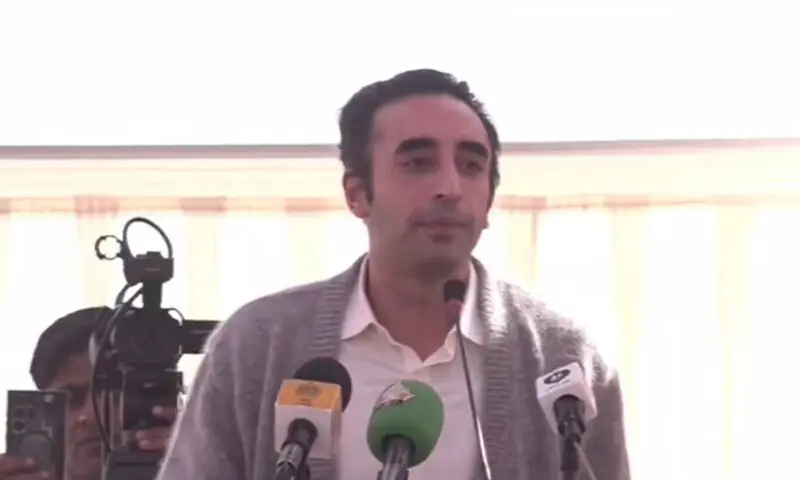
HYDERABAD: PPP Chairperson Bilawal Bhutto-Zardari on Wednesday alleged, without naming anyone, that “some powers” wanted to rob Sindh of its rights and transfer its resources to Islamabad on the pretext of claims that the provincial government had performed poorly.
He made this statement while speaking at the inauguration ceremony of the first phase of Tharparkar Institute of Engineering, Science and Technology in Tharparkar.
“Efforts are made, a campaign is run to assassinate the character of not just Tharparkar but your entire province as part of a conspiracy and for a particular objective. Some forces want to rob your province of its rights and resources and have them transferred back to Islamabad on the pretext that the Sindh government has not done anything,” he alleged.
He added, “I believe that the answer to this false narrative is Tharparkar. You can see how Tharparkar was before 2008, before the 18th Amendment, and how it is in 2026. Yes, there are problems, but the Tharparkar of 2026 is before you all [to see].”
Bilawal further stated that the people of Thar had “always supported the PPP in every election”, terming this trend an expression their love for the party and late prime ministers, Zulfikar Ali Bhutto and Benazir Bhutto.
The PPP, he continued, reciprocated this fondness by “always striving to develop Tharparkar”.
“Tharparkar’s progress is essential for Pakistan’s progress, just the way the progress of all four provinces is essential for the entire Pakistan”, he said.
Bilawal further stated that coal was an asset for the people of Tharparkar, adding that Tharparkar had as much coal as Saudi Arabia had oil. But unfortunately, the government “does not have the power to utilise these resources, and whenever Benazir Bhutto tried to do so, her efforts were sabotaged as part of a conspiracy”, he said.
He said it was the misfortune of the entire country that the economic development that should have been witnessed in the province in 1993 kept eluding it until 2008.
“But the people witnessed that just one project led to an economic revolution in Tharparkar,” Bilawal said. “The economic benefits of the electricity produced here are seen in Faisalabad as well.”
In this connection, he further said that the “very first megawatt [of the electricity produced in Tharparkar] was transferred to the national grid for use by industrial centres. This is how strong federal governments work”.
The PPP chairperson said economic development in Tharparkar also triggered a “social revolution”.
“This area didn’t have basic health units, dispensaries and hospitals, but now, with the government’s investment, we have laid a health network in Tharparkar. While coming to Thar, I saw the Thar Foundation, which receives a share from the profit generated from coal to ensure that social work continues and to run a hospital.”
About the Tharparkar Institute of Engineering, Science and Technology, he recalled that the Nadirshah Edulji Dinshaw University of Engineering & Technology initiated the project in 2019.
“The chief minister has promised that by the time the current [provincial] government completes its term, this campus will be running as a university,” Bilawal said. “The same way, we will keep working in Sindh. We think about the interests of the people of Sindh and will keep executing projects.”
He claimed the number of universities in Sindh had doubled since 2008, further stating: “We would like to compete with other provinces because Sindh has excelled in [the] health and education sectors.”