
Even in a show called Lazawal Ishq [Eternal Love], it seems that Pakistani women are doomed to perform domestic chores, regardless of how they dress or where they are.
Lazawal Ishq, an Urdu reality show about partnerships, is based on the Turkish show Ask Adasi. The show centres on five buff young men and five fashionably dressed young women who are ensconced in a luxury villa on an island, sleeping on separate floors.
Deprived of mobile phones and other electronic devices, they are forced to connect with each other. The cameras capture most of their conversations, giving viewers insights into their evolving alliances. Over the course of 100 episodes, new contestants are introduced to test the strength of each couple’s relationship. Those who end up single are sent home in the “elimination” episodes. The couple most likely to wed after the show will be crowned the winners.
Having watched 43 episodes so far, I observed the heart-warming, non-romantic bonds of friendship among the housemates and the unhealthy communication patterns among the partners. But what stood out to me was how the young female participants ended up taking on traditional domestic duties.
Tradwives
Take the example of Urooj Shamim, a Karachi-based model. Early in Lazawal Ishq, she labours in the contestants’ shared contemporary minimalist kitchen over a chicken karrahi for all her housemates.
The reality show Lazawal Ishq reveals just how deeply ingrained Pakistani socio-cultural norms are and how they hinder women’s agency and mobility
Atypically, she cooks it in a shallow frying pan, dressed in a long, form-fitting dress, with coiffured hair and make-up. It instantly reminded me of an internet phenomenon: the “tradwife” or traditional wife — the belief that women are better off when they abide by traditional gender roles and are also well put together.
Later in the episode, Urooj tells Fatima Lodin, a California-based dental student contestant, that when they were in their room at night and allowed access to their electronic devices, she went further into meal-prepping mode by consulting her mother for guidance and watching cooking videos on YouTube.
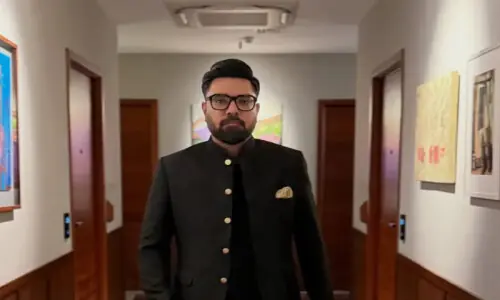
In contrast is her partner, Hamza Abbasi (not the actor). In a subsequent episode, he promises to wake up early and wash their clothes and bedsheets together, a task I can never imagine most Pakistani men ever suggesting, let alone doing. He wakes up late. Urooj goes ahead with the laundry. She complains to the other contestants, while Hamza explains to everyone that if Urooj had woken him up, he would have carried out the task. As if.

As the show progresses, she continues to ensure her partner is well fed at all meal times. Clearly, Urooj is leaning into this tradwife role, because cooking, cleaning and caring for one’s husband (partner, in this case) is expected of women.
Another female contestant, Batool Abidi, often clad in bandage dresses during the day, takes on the avatar of a roti-rolling tradwife in the evenings, wearing silk night suits and a bunny ear headband. Not content with this self-appointed duty, she often brews coffee and tea for everyone.
It was a relief to watch Batool’s partner, Sheeraz Ali, point out to her that it wasn’t her responsibility to feed everyone and that her self-appointed kitchen duties were affecting their relationship.
Data
Numerous studies, statistics and research back up my view — Pakistani women are socially conditioned to take on a disproportionate amount of home responsibilities when compared to men, which is clearly reflected in Lazawal Ishq.
According to a 2015-2016 United Nations report — Progress of the World’s Women: Transforming Economies, Realising Rights — Pakistani women do 10 times more unpaid labour and domestic work compared to men.
In terms of time, Pakistani females were found to spend, on average, 231 minutes daily, or nearly four hours, on household work. This was estimated in 2009 by the Government of Pakistan’s Finance Division and published in Valuation of Unpaid Care Work in Pakistan. It was also discovered — in a 2023 research study conducted by the Pakistan Institute of Development Economics — that Pakistani women allocate their longest time in the kitchen for cooking.
Beyond obscenity
There has been severe backlash against Lazawal Ishq and its host Ayesha Omar, who appears in ‘daring’ attire. So much so that a petition was filed in the Islamabad High Court, claiming the show was full of “obscenity”, which was leading to “moral decay”. The court was to hear the case on November 20, though no updates have emerged since.
Several complaints were also filed with the Pakistan Electronic Media Regulatory Authority (Pemra), which later clarified that the show was broadcast on a social media platform, not on any TV channel licensed by Pemra and hence it was not subject to its rules. However, after airing 50 full episodes, the show was taken off the web in Pakistan, although clips can still be watched on its YouTube channel.
But beyond the denunciations, this show reveals how deeply ingrained Pakistani socio-cultural norms are, which hinder women’s agency and mobility. I formulated this insight when I re-watched the first complete episode of Lazawal Ishq (before its full episodes were pulled back in Pakistan), to hear what the contestants said about their work.
Nearly all the male contestants said that, besides modelling or acting, they were also entrepreneurs, whereas the women said they were only models, actors, working professionals or students. Evidently, the men have time and space to do several things, whereas the women could do one or, at most, two other things. And it is safe to say this is because women are highly burdened with domestic responsibilities.
Again, this observation is backed by research and data. According to the October 30th, 2025 International Labour Organisation news, around 60 percent of women in Pakistan spend over 15 hours a week on domestic tasks that “leads to a time and opportunity poverty for women.”
Gender studies researchers (Husbands’ Involvement in Domestic Chores and Family Conflicts: Empirical Evidence from Pakistan, 2020) attribute this to Pakistan’s non-egalitarian and patriarchal societal structure, in which men are more involved in paid work, and women are restricted to unpaid domestic roles. Even though it seems more Pakistani women are receiving higher education and there is an increase in employment opportunities for them, data belies this myth.
According to the UN Women’s 2023 National Report on the Status of Women in Pakistan, the total female labour force participation rate of women in Pakistan is 21 percent. This is well below the global average of 39 percent.
Need to chip in
As Lazawal Ishq progressed, I continued to watch its hour-and-a-half-long episodes throughout the day — entertaining, tedious and fascinating in parts — in the hope that the muscled male participants would take on household tasks willingly. I was rewarded when, in an episode, Junaid and Hamza promised to make breakfast for their partners. Hamza follows through, scarred after Urooj’s earlier taunts for not waking up on time to do the laundry together.
But not Junaid Akhter. Unlike Urooj, Junaid’s partner, Ayesha Ejaz, does not make her own breakfast. She waits for Junaid, who is sleeping away. He wakes up late in the afternoon and ends up making her breakfast. For me, Ayesha’s act implied a deeper meaning: both men and women need to chip in with housework. And if the men avoid it, that does not mean women should take on their partners’ share.
Instead, ways should be thought of to have them contribute to household work.
Lazawal Ishq continues on YouTube — full episodes can be viewed in Pakistan using VPNs — with newer female entrants who continue to perpetuate these gendered roles and responsibilities.
The writer is a long-time journalist who writes on the intersection of culture and feminism. She also runs The Awara Pairha Blog about food scenes on screen and is working on a culinary memoir
Published in Dawn, ICON, January 4th, 2026