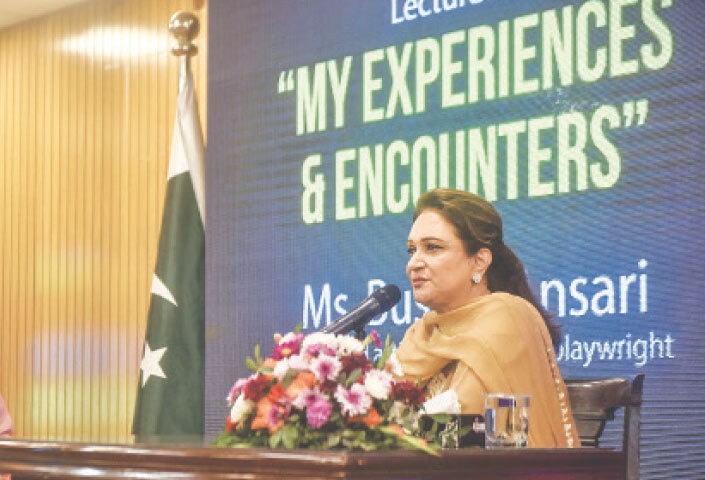
KARACHI: Listening to artist, singer and playwright Bushra Ansari speak about her life experiences and encounters as part of the Sindh Madressatul Islam University’s (SMIU) Popular Lecture Series on Thursday was a treat for both students and staff of the university.
Presented in the form of a one-on-one conversation with Assistant Professor and Departmental Coordinator in SMIU’s Department of Media and Communication Studies, Dr Sumera Memon, Bushra spoke from her heart about several issues such as growing up in Lahore amid intellectuals and revolutionary activists, motherhood, work, humour, Pakistani dramas and so much more.
She was born in Karachi but grew up mostly in Lahore in a journalist’s home. Her father Ahmad Bashir was also an activist and he would always be in trouble at the newspapers he worked with for telling the hard truth. He also gave up his job of information officer to study film-making but the film he made later flopped. He also studied homeopathy.
“Bushra”, her name, means happy news. She was named Bushra by one of her father’s friends, Ibne Insha. Bushra was a tomboy, riding bicycles and climbing trees. With two older sisters and a brother and sister younger than her, she was the middle child who was not really the main focus of her parents’ attention. “We kids also didn’t demand too much. We were grounded and practical children who were happy going to school or college and returning by bus. Our father liked music but he did not want his daughters to sing,” she said, adding that she started singing at the age of nine to his horror.
Becoming a star later, she said that she never developed a star-like attitude, leaving her house to servants. “I cooked, I took care of my daughters, drove them to school and back, while also taking good care of myself since I was a star. I took on pressure but never lost my focus while keeping my priorities in check. Even when I was on tours abroad, I took my daughters with me. I never neglected them. I took very good care of them. They were my projects from God. I may have lost sleep but I achieved my goals and met my demands of stardom,” she said.
She said that despite facing multiple challenges in life, she carried on. “You just focus on your goals and aims and don’t stop. Success is not planned but it comes with hard work. It is always like that no matter which field you may belong to.
“Life, too, can be a roller coaster ride. I got married to my second husband, Iqbal Hussain, at 60 and am glad to have found in him a good partner. We carry a lot of respect for each other.”
She said that she started work as a puppeteer with Farooq Qaiser in Islamabad to then come to Karachi to work with Moin Akhtar and Anwar Maqsood. All three were and are legends in their own right. She also said that humour has seen a drastic change over the years. “People have started laughing at vulgarity. Content creators or influencers, too, these days think that insolent behaviour is amus come to Karachi to work with Moin Akhtar and Anwar Maqsood. All three were and are legends in their own right. She also said that humour has seen a drastic change over the years. “People have started laughing at vulgarity. Content creators or influencers, too, these days think that insolent behaviour is amusing. But it is not. We used to make people laugh with simple and clean humour. We still do. If our content creators are successful today with this kind of content, then it is our failure,” she pointed out.
Coming to the Pakistani drama industry, she said that production houses see dramas as investment. They want to profit from them so they only make what sells. “That’s why stories are being repeated and there is hardly anything new coming out. Being a playwright also, I try to pen different stories. One such story of mine has been lying in my desk drawer for 18 years because no production house wants to experiment. They want to play safe,” she said.
“But despite this, our dramas have realism. They don’t have that in India where they may show women laden with make-up and jewellery working in kitchens,” she laughed.
When asked about the favourite characters she played, she said that they keep changing. “There was the humorous character of ‘Bijli’, also Jahan Ara Begum in Angan Tera, the Sikh woman Bilqees Kaur and Mrs Chaudhry, which I liked doing but then I think that maybe I could have done this or that differently,” she said. “Anyway, no writer here is writing good and meaningful roles for women of my age now. In India, they are still writing roles for Amitabh Bachchan, Neena Gupta and Shefali Shah but it does not happen like that out here,” she added with a sigh.
Published in Dawn, January 2nd, 2026