7
7

As the sun dipped into the waters off Karachi’s Seaview on a chilly Thursday evening, a festive air settled over AK Khan Park along the promenade.
Men and women of all ages, with children alongside, gradually filled the park. Patiently queuing at counters marked in vibrant black and turquoise branding, they collected what would soon become keepsakes: running bibs for the 2026 Karachi Marathon.
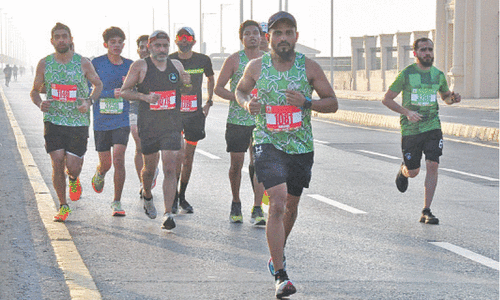
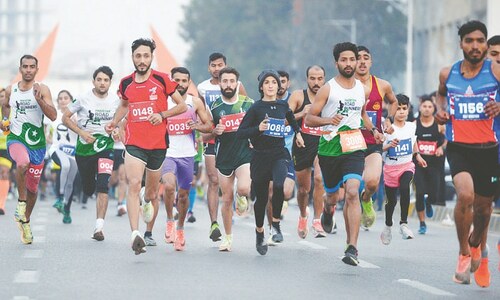
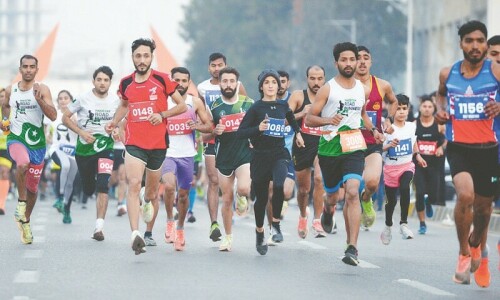
On Sunday, with these bibs — fitted with time-tracking chips — pinned to their running gear, participants will line up at the promenade near Nishan-i-Pakistan Park.
Runners competing in the full and half marathon categories will begin before sunrise at 6:30am, while those taking part in the five-kilometre race (commonly referred to as the 5K) will start at 9:00am.
More than 2,000 runners have registered for the marathon events. Registrations for the 5K, meanwhile, remain open, with over 3,000 participants already signed up.
This will be the third edition of the Karachi Marathon, which is recognised by World Athletics and has its distance professionally certified by the Association of International Marathons and Distance Races (AIMS).
Shaheer, an 18-year-old student at NED University, first experienced competitive running when he participated in the 5K at last year’s event. This year, he is stepping up to the half marathon.
“I love playing sports — I play basketball quite regularly — but running has a different feeling to it, a feeling that is hard to describe in words,” he told Dawn, smiling broadly. “It is about pushing yourself to the limit, to test how far you can go. It is a unique experience.”
Long-distance running is a passion shared by many in the sprawling metropolis. Some train alone in neighbourhood parks and streets, while others prefer the motivation of running in groups.
The arrival of the Karachi Marathon three years ago has given these enthusiasts both a platform and a goal.
Suriyami Wong, an Indonesian national who has lived in Karachi for 22 years, discovered her love for running in 2024 and has been training for the half marathon — her first — since last year.
“I run for mental clarity and for exercise. It’s not just the run itself, but the training that goes into it — the discipline and the consistency,” the 45-year-old told Dawn. Wong believes such events have a direct impact on the city’s culture.
“This is a World Athletics-certified event, so its standards are comparable to marathons held anywhere abroad,” she said. “Especially in Karachi, where people struggle to step out of their comfort zones even to walk or run, such events make a huge difference by giving people the motivation to come out.”
The marathon route, however, is confined to some of the city’s most affluent localities — zones largely insulated from the chaos of the old city and neighbourhoods home to middle and lower-middle-class populations.
While marathons ideally reflect the culture and character of a city, the current route passes without a single iconic heritage landmark, completely bypassing Karachi’s historic core.
The organisers are conscious of this limitation.
“This is not what I can call my city,” said Shoaib Nizami, the driving force behind the Karachi Marathon, speaking to Dawn. “This is my city,” he added, as he played a promotional video on his phone showing athletes racing through Saddar and sweeping past Empress Market, Merewether Tower and Frere Hall.
“We have already had our new routes approved; it is only a matter of time before we go into the city.”
Karachi Mayor Murtaza Wahab — whom Shoaib described as the ‘custodian of the Karachi Marathon’, in line with international practice — echoed these sentiments at a press conference on Thursday.
“I wish to see next year’s marathon held inside the city, starting from Mazar-i-Quaid,” he said. “We will take the lead — the KMC will come forward, and so will the government.”
But before the Karachi Marathon makes that journey inward, thousands of runners will undertake journeys of their own — not just from Nishan-i-Pakistan Park to the DHA Golf Club, but from passion to purpose, and from anonymity to identity.
“No one knew Barcelona before the [1992] Olympics, but it came onto the world map after that,” Shoaib said. “Events like the Karachi Marathon will bring our city to the world map.”