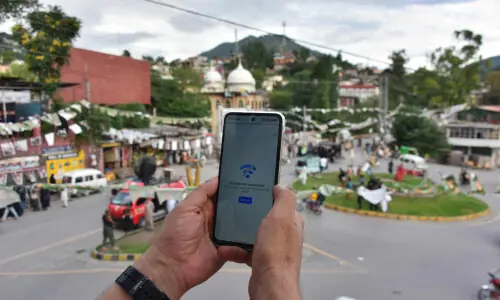


THE advent of WhatsApp has transformed the way people use mobile phones. The increasing use of the app is drastically reducing reliance on emails, SMS and even bringing down the number of SIM-to-SIM calls. This shift towards technology is apparently reducing the income of cell phone companies and prompting telcos to venture into other avenues to keep themselves afloat.
Whereas WhatsApp has sped up communication and made sharing of information more convenient, the proliferation of WhatsApp groups — particularly adding one to the group without one’s consent — has become a nuisance for a large number of users. Group members share irrelevant news and posts defying the very purpose of a particular group. For example, a group made for sharing sports-related news loses its relevance if politics, entertainment or other unrelated content is shared on it. Similarly, a WhatsApp group for entertainment should strictly focus on its niche and not on other topics. Moreover, morning greetings shared in groups are a major irritant for members.
Also, in multiple WhatsApp groups, messages in the form of text and images are shared frequently without verifying their authenticity. Unfortunately, group members further share such messages to other groups speeding up the spread of fake news. A recent incident of fake news spread via WhatsApp groups came to light when a false notification declaring September 9 as a public holiday was circulated via multiple groups. The spread of this fake news was so powerful that people started believing in this notification. The relevant federal ministry had to issue an official clarification to clear the air. In another incident, WhatsApp groups played a vital role in the spread of news regarding a false rape incident at a Punjab college, causing large protests and forcing the authorities to strongly deny the incident. The rapid spread of fake messages about closure of WhatsApp has caused much distress among users. The Pakistan Telecommunication Authority has reportedly issued an alert against such messages, and asked the users to ignore them.
These are just a few examples but users regularly face the challenge of differentiating between fake or genuine news. Sharing fake quotes with the name of political and religious leaders is also a frequent occurrence on multiple WhatsApp groups. In some journalist-specific groups, images of dead bodies and bloody crime scenes is shared, causing distress to the users. Without doubt, rapid circulation of fake news through WhatsApp groups creates panic, confusion, and can even lead to violence in some instances.
WhatsApp groups can be less cumbersome if protocols are followed.
WhatsApp groups can be less cumbersome if protocols are followed. I suggest that members should avoid spamming the groups with irrelevant messages. The messages can be posted in one chunk instead of dividing them. We must also show tolerance for other group members and avoid arguments, heated discussions or displays of hatred. It is suggested to stay on the main topic and avoid sharing irrelevant messages. One-on-one conversations in the group should also be avoided. Users should refrain from posting in the group late at night and early in the morning unless it is absolutely necessary.
Group admins should remain vigilant about what is being shared. They should set clear rules and guidelines for the group and take immediate action in order to protect the sanctity and purpose of a group. Members who violate the guidelines should be first warned and then removed if they continue to be a nuisance for other members. It is the responsibility of group admins to manage such issues in order to mai-ntain the decorum among participants. When making a news WhatsApp group, it is critical to take consent of the person before adding them as non-consensual inclusion is unethical and a source of irritation for the prospective member.
WhatsApp groups are supporting media personnel, freelancers and content creators, communications professionals and many other segments of society in getting the required information without actually going to the event.
The groups have also helped reconnect lost friends on one platform and helped in reviving old friendships and relationships. These groups are also a good source of recovering data in case of loss due to phone snatching or a technical fault caused in the handset.
However, being a member of WhatsApp groups is not all doom and gloom. There are significant benefits, particularly for professionals. But members need to be careful about what they share and also avoid becoming a source of irritation for others in the group.
The writer is a freelance contributor.
Published in Dawn, December 23rd, 2025