Celebrating world’s cacophony for the first time
• ‘I can feel her excitement,’ says mother after child hears sound following cochlear implant surgery performed by a UK-based charity
• Doctors recommend intensive speech therapy to ‘truly benefit’ from the device
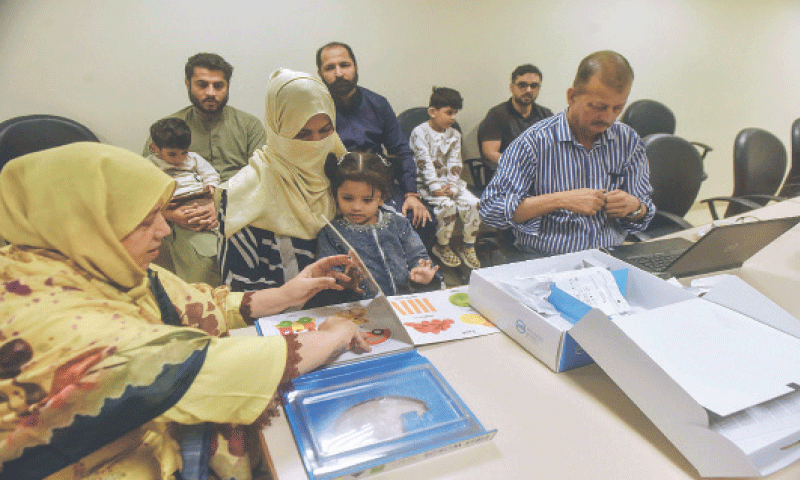
KARACHI: Sitting on her mother’s lap at a hospital, two-year-old Zunaisha responds in a very subtle way when doctors activate her internal and external hearing devices, ending the silence that has surrounded her since birth.
Her mother, assisted by a speech therapist, who has been working hard with her for the past four to five months, however, is certain that Zunaisha has started picking up sounds, for the first time.
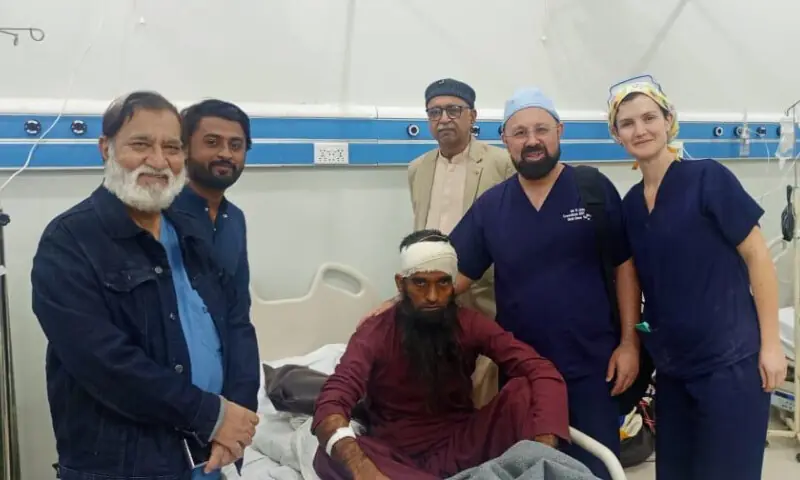
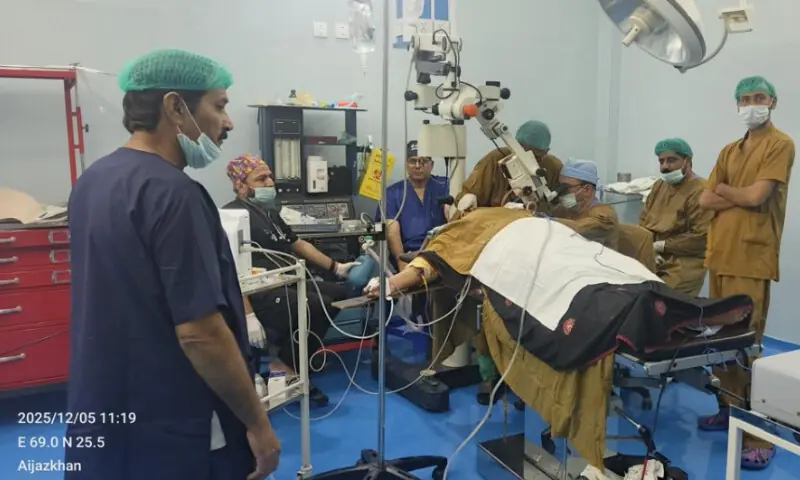
“I can feel her excitement. I am so happy,” her mother Areeba shared with Dawn at the Memon Medical Institute Hospital (MMIH), where recently a UK-based charity organisation — International Medical Relief Agency (IMRA) — held its ENT (ear, nose, and throat) camp.
Born with profound hearing loss over two years ago, Zunaisha received a cochlear implant — a surgically implanted electronic device for the treatment of severe to profound hearing loss in children and adults — last month by IMRA team comprising several UK experts.
Three weeks later, doctors activated the whole system after fitting external components, including a sound processor, behind her operated ear.
“Zunaisha is actually born today; she has taken her first step towards language development that would help her connect with the world. This is what we tell parents and ask them to be patient till their child begins to speak,” said senior speech therapist at IMRA Farhat Zehra.
“Parents really need to dedicate their time to their child who needs speech therapy sessions for at least two to three years to truly benefit from the device and start a normal schooling,” she added.
Seconding her opinion, senior audiologist at IMRA Syed Sajid Yaqoob said usually parents believed that their job was over once the child started listening with the device’s help.
“The implants can transform lives. However, children need intensive speech therapy training to decipher the signals they generate,” he said.
Dr Shaukat Malik, IMRA Pakistan President, said a cochlear implant bypasses damaged parts of the inner ear and directly stimulates the hearing nerve, offering a chance for improved speech and language.
Children with hearing disability, he pointed out, are initially helped by a hearing aid four to five months prior to the operation to get them used to wearing the device.
“Early diagnosis of hearing disability is crucial. Children aged one to two years are considered the best candidates. The second step is to choose parents who are willing to provide the child with extensive training to benefit from the costly device,” he said.
Zunaisha was not the only lucky child to have been offered the chance to experience a childhood with perfect hearing. The children benefitting from the cochlear implants included Zain, Zara and Hasan.
The UK-based charity funded and provided their complete treatment, from their initial registration at an IMRA-run clinic and speech therapy sessions to the implant at the hospital.
“We offer consistent support to parents and children by holding follow-up sessions. The software of their implant devices is upgraded depending on children’s progress,” Dr Malik said.
Raising hopes
Giving his feedback on the medical camp, Dr Noweed Ahmed, a UK-based specialist heading the IMRA’s cochlear implant programme, said: “Our aim is to look after children born with hearing loss, giving them back the gift of hearing and speech.”
According to Dr Ahmed, also a skull base and cochlear implant surgeon and neurotologist who has also received training in Canada, Australia and the US, the initiative launched in 2012 has now become world’s largest charitable cochlear implant programme.
“My role was to set up the cochlear implant programme. We started from Karachi and, over the years, have expanded to other cities of Pakistan, including Lahore and Islamabad,” Dr Ahmed said.
According to experts, approximately two to three infants per 1,000 are born deaf or with severe to profound hearing loss. Initial signs include baby’s inability to meeting their developmental milestones to speak, play or communicate.
“The causes range from hereditary hearing loss to improper development of the inner ear. Hearing loss can also occur after birth and may be related to infections or other medical problems that occurred around the time of delivery,” said Dr Qaiser Sajjad, secretary general of IMRA, adding that cousin marriages increased the risk for congenital or genetic diseases manifold.
While cochlear implant surgeries remain an important area of the organisation’s operation, IMRA’s doctors have been handling and treating complicated cases of chronic ear infections in Pakistan since launch of its operation in 2009.
Highlighting the organisation’s extensive work in the ENT field in Pakistan, Dr Haroon Khan, Founder and Chair of IMRA, says, “So far, over 2,000 patients suffering from chronic middle ear infections have benefitted from surgeries while 216 children have received cochlear implants — each implant device alone costing around Rs2m. The organisation also offers scholarships to Pakistani doctors to hone their skills in the UK.” The organisation, he says, has twice received the British Medical Association’s Humanitarian Award and part of the WHO’s forum on deafness.
“We are in the process of expanding our charitable work in Pakistan and holding camps in Mirpur, Azad Kashmir, and Peshawar,” Dr Khan said, adding that the organisation also held camps in Somalia.
Last month, the team held a total of six camps in Karachi, Mirpurkhas and Multan, carrying out over 60 surgeries including thyroid and endoscopic operations, all carried out free of cost at different hospitals.
Published in Dawn, December 21st, 2025