Seed watchdog cutbacks spark yield fears
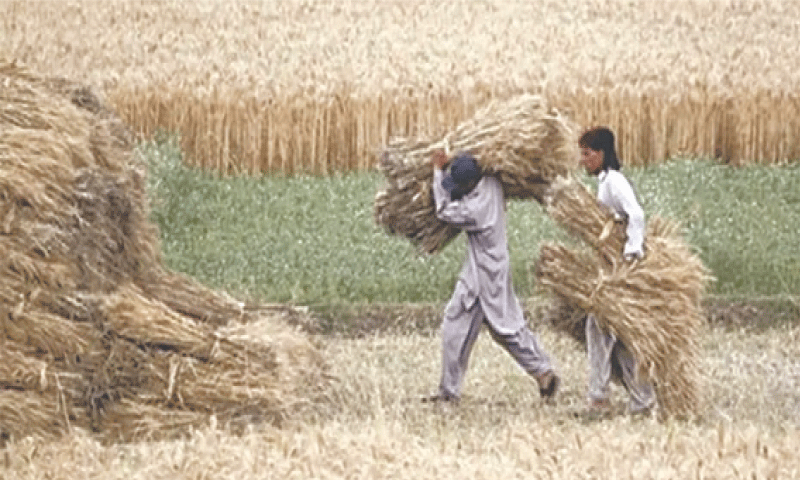


LAHORE: The federal government’s decision to send nearly 70 per cent of the staff of the Federal Seed Certification and Registration Department (FSC&RD) to the surplus pool has triggered alarm nationwide, with experts warning of serious disruption to certified seed production and a possible record fall in per-acre yields of key crops, including cotton, wheat and rice.
For decades, the FSC&RD has been responsible for registering seed companies, regulating and monitoring certified seed production, and taking action against the sale of substandard seed. Operating under the federal government, it maintained offices in most major agricultural centres and played a crucial role in ensuring farmers’ access to quality seed despite limited resources.
Experts say the sharp staff reduction, part of a broader move to downsize or abolish departments, has left FSC&RD offices severely understaffed. Although the department has not been formally shut down, the transfer of most of its workforce has effectively paralysed operations, raising fears that farmers will be forced to rely on low-quality seed.
This, they warn, could result in a record decline in per-acre yields of cotton, wheat, rice and oilseed crops, directly hurting farm incomes and pushing Pakistan towards costly imports running into billions of dollars.
Cotton Ginners Forum Chairman Ihsanul Haq said Rahim Yar Khan held a unique position in the seed sector, producing at least 70pc of the country’s certified seed. Previously, the local FSC&RD office had a deputy director, four seed certification officers and 14 technical and junior staff, with seven additional officers posted during peak cotton and wheat inspections. Now, he said, all but one officer and one clerk have been sent to the surplus pool, virtually halting certified seed production in the district.
Around 1,150 public and private seed companies operate across Pakistan, more than 200 of them in Rahim Yar Khan, producing certified seed of cotton, wheat, rice, mustard, mung bean and sesame. The absence of effective regulatory oversight, Mr Haq cautioned, poses serious risks to the national agricultural economy.
He said reports that the federal government was considering two or three alternative models for certified seed production had failed to ease concerns, as the lack of clarity had already created uncertainty. Farmers, he warned, could face acute shortages of certified cotton and rice seed in the current season.
Mr Haq also noted that the government had decided to introduce a three-tier monitoring system — Green, Yellow and Red — for imported seeds, including cotton.
Published in Dawn, December 14th, 2025