IMF sees Pakistan stepping back from default risk


The latest International Monetary Fund (IMF) projections for Pakistan suggest that the immediate risk of economic free fall has eased but the country remains locked into a narrow stabilisation path marked by weak growth, heavy debt and limited relief for households.
Projections by the Fund, released early on Tuesday alongside the statement announcing a fresh disbursement of around $1.2 billion to Pakistan, showed that the country’s economic growth was projected to inch up from 2.6 per cent in FY2024 to 3.2pc by FY2026, a pace that barely matches population growth in the country of 240.5 million people.
With a per capita income of $1,677, this trajectory points more to economic containment than recovery.
Pakistan’s population also continues to grow at a high pace, with mid-2025 official figures citing 2.55pc, while World Bank data points to 1.8–1.9pc. Though slightly lower than past peaks, the rate remains a significant development challenge.
Pakistan, however, appears to have made the most striking turnaround in inflation. After averaging 23.4pc in FY2024, consumer prices are estimated to have fallen sharply to 4.5pc in FY2025, and projected to rise to 6.3pc in FY2026.
End-period inflation is also projected to ease from 12.6pc in FY2024 to 3.2pc in FY2025, before climbing to 8.9pc in FY2026. The disinflation reflects tight monetary policy, lower subsidies and compressed demand under the IMF programme, though the projected rebound suggests price stability remains fragile.
Labour market conditions offer limited comfort. Unemployment is projected to fall only modestly from 8.3pc in FY2024 to 7.5pc in FY2026, underscoring the weak job-creating capacity of the current growth path.
On the fiscal front, the adjustment underway is substantial. Government revenue and grants are projected to rise from 12.7pc of the gross domestic product (GDP) in FY2024 to 16.3pc by FY2026, while expenditure is expected to remain near 20pc of GDP.
As a result, the budget deficit is projected to narrow from -6.8pc to -4.0pc of the GDP. Pakistan is also projected to maintain a primary surplus rising to 2.5pc of the GDP, a central IMF benchmark.
Despite this tightening, the public debt burden remains heavy. Total general government debt, including IMF obligations, is projected to hover around 72–73pc of the GDP, while government and guaranteed debt is expected to stay near 76pc.
Domestic debt accounts for nearly half of the GDP, keeping interest costs elevated amid high domestic borrowing rates.
External pressures have eased but vulnerabilities persist. The current account balance is projected to remain close to zero, shifting from a 0.6pc of GDP deficit in FY2024 to a 0.5pc surplus in FY2025, before slipping back into a small deficit in FY2026. Foreign exchange reserves are projected to rise from $9.4bn in FY2024 to $17.8bn by FY2026, lifting import cover from 1.6 months to 2.7 months — an improvement, but still short of comfortable levels.
Foreign investment, however, remains subdued. Foreign direct investment (FDI) is projected at just 0.5–0.6pc of the GDP throughout the period under review, pointing to persistent investor caution despite improved macro stability.
Monetary conditions also remain tight. Broad money growth is projected in the 14–16pc range, while private sector credit growth, though improving from 6pc to 15pc, remains constrained by high interest rates. The six-month treasury bill rate stood at 21.5pc in FY2024, reflecting the heavy cost of domestic borrowing.
Meanwhile, the 15.4pc real effective appreciation of the rupee in FY2024 signals a shift towards currency stability after a period of sharp depreciation, though it also carries risks for export competitiveness in an economy where textiles, valued at $17.3bn, remain the dominant export.
Taken together, the IMF projections depict an economy that has regained short-term stability through sharp fiscal and monetary adjustment, but remains burdened by high debt, weak investment and slow employment growth.
The immediate crisis may have passed, but the challenge of translating stabilisation into sustained, inclusive growth remains unresolved.
‘Stability achieved, more efforts needed for growth’
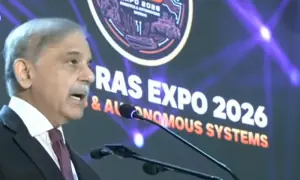
Meanwhile, Prime Minister Shehbaz Sharif has termed the latest IMF disbursement a “proof that Pakistan is making progress in implementing the necessary steps for economic stability and growth”, according to state broadcaster Radio Pakistan.
A statement carried by Radio Pakistan further quoted the premier as saying that “the IMF’s expression of satisfaction with the effective implementation of economic reforms and measures in Pakistan is a clear testament to the hard work of Finance Minister Muhammad Aurangzeb and his team”.
The statement added that the PM also acknowledged that Chief of Defence Forces and Chief of Army Staff Field Marshal Syed Asim Munir “played a key role in supporting the implementation of the reform agenda and paving the way for Pakistan’s economic development”.
He said that steering the country from the brink of default toward stability and growth was a “challenging phase, requiring collective sacrifice from everyone”.
“Political parties sacrificed politics, and the nation endured economic hardships to make the impossible possible,” he was quoted as saying.
Moreover, PM Shehbaz expressed satisfaction that Pakistan’s economic reforms and digitisation [process] had “become a successful case study and an example for the world”, the statement said, adding that the premier also expressed the confidence that the “dream of Pakistan’s economic development will soon be realised”.
He said that while “stability had been achieved, more efforts are needed to move the economy toward growth”.
The PM expressed his “firm commitment to working diligently for the prosperity of the people and completely freeing the country from foreign debt. He is confident that time is not far when Pakistan will achieve economic self-sufficiency after getting rid of debt”, the statement said.