Pakistan successfully emerged as ‘regional stabiliser’ following ‘Marka-i-Haq’, says PAF chief



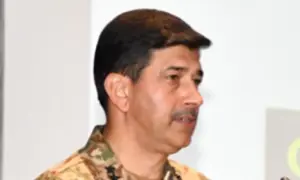
Air Chief Marshal (ACM) Zaheer Ahmed Baber Sidhu on Tuesday noted that Pakistan had emerged as a regional stabiliser after the May conflict with India.
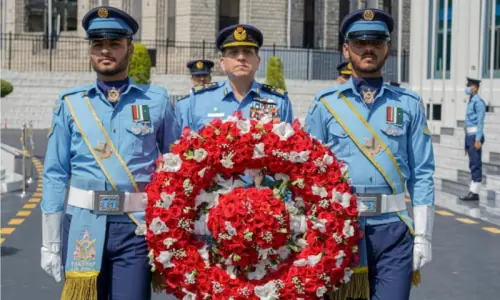
The Pakistan Air Force (PAF) chief made the remarks during the passing out parade at PAF Academy Asghar Khan in Risalpur in Khyber Pakhtunkhwa’s Nowshera district.
“In the wake of Marka-i-Haq, Pakistan has successfully emerged as a net stabiliser in this part of the world,” ACM Sidhu said.
“As a responsible nuclear power, our relations with key global and regional powers have further strengthened, which is a testimony to the untiring effort of our diplomatic strategy and credible military prowess.”
The Pakistan Army had named the period of conflict with India, from the April 22 Pahalgam attack to the May 10 conclusion of Operation Bunyanum Marsoos, as Marka-i-Haq in May.
“The rising global relevance of Pakistan remains a growing concern for our adversary, and it exploits every opportunity to malign and destabilise Pakistan on the international front,” said the air chief in a veiled reference to India.
Speaking further on the May conflict, ACM Sidhu said, “The people of Pakistan and its armed forces defeated the enemy with far greater numerical might.
“This resounding success during Marka-i-Haq and Bunyanum Marsoos was the outcome of a unified approach by all elements of national power, and above all, Allah’s special blessing.”
The PAF chief highlighted: “Undoubtedly, the victory also reflects great credit on the firm resolve of our national leadership alongside well-executed tri-service synergy, aggressive decision-making, and full support of Field Marshal Syed Asim Munir.”
He reiterated that the “strength of military organisation solely hangs upon a value system based on character and credibility”, asserting that the PAF’s each and every claim was based on “evidence and undeniable hard facts”.
During his speech, the air chief noted that “we live in challenging times in the wake of a complex global and regional environment”.
While affirming that Pakistan “wishes to maintain friendly relations with all, especially with our neighbours”, ACM Sidhu warned: “However, let me make it clear; if our nation’s sovereignty is challenged, our adversary will find Pakistan’s armed forces even harder and better prepared.”
He asserted, “While celebrating this success with humility, we singularly remain focused on preparing for the future challenges, as the enemy’s rhetoric continued to suggest.”
‘PAF’s first full-spectrum multi-domain operation’
ACM Sidhu highlighted that the PAF conducted “full-spectrum multi-domain operation” for the first time in its history, employing elements of “space, cyber and electronic warfare, along with long-range vectors, unmanned aerial systems, killer drones and loitering munitions”.
Recalling the downing of multiple Indian jets on May 7, the PAF chief noted that it was being “regarded as one of the most intense and longest BVR vs BVR (beyond-visual-range) battles of modern aerial history”.
On the subsequent missile exchange on May 10, he said, “We also responded to their pre-amption on May 10 with the Pak Army with a paralysing punch, and struck their bases and ground assets deep into the enemy territory from north to south.”
He added that the armed forces also “neutralised state-of-the-art defence system S-400 and command and control centres” of India. He said the operations were “calibrated and balanced with a single aim to ensure peace with honour”.
The air chief added that the PAF’s “mastery and employment of multi-domain capabilities is being acknowledged and studied by warfare professionals around the globe”.
‘PAF vigorously pursued very innovative strategy of modernisation’
The air chief noted that the PAF’s performance during Marka-i-Haq was not an isolated event but the “outcome of a comprehensive strategy of restructuring, modernisation and indigenisation campaigns undertaken” by the air force in the past few years.
The PAF, he said, recognised the “rapidly changing character of war” and realigned its “operational doctrine, concept and strategy, keeping in view the limitations of fiscal space and availability of technologies”.
ACM Sidhu noted that the PAF “vigorously pursued a very innovative and practical strategy of modernisation and adapted, as well as operationalised, numerous advanced combat and combat-support capabilities, along with niche technologies in record time”.
“The smartly executed homeground kill chain comprising indigenously developed unmanned system, EW and space assets, along with cyber capabilities developed in record time under the ambit of newly established National Aerospace Science and Technology Park (NASTP) form the very core of PAF’s multi-domain operational strategy.”
The PAF chief said the range and capabilities of the NASTP were “expanding at an unprecedented pace”, adding that “a host of indigenous projects are still in the pipeline that are being vigorously pursued”.
“Indeed, through rigorous retrospection, concept development, validation cycle, war gaming, the Pakistan Air Force now stands as a vault into the operational ecosystem whose manifestation was seen during the recent conflict.”
‘Recent paradigm shift in training’
Congratulating the graduating cadets, the air chief said, “Today marks the beginning of your journey in one of the most distinguished, respected and professional air forces of the world.”
“Indeed, you are entrusted with the noble mission of defending the aerial frontiers of the motherland, and carry on the hopes of the entire nation on your young shoulders.
“You are being trained well at this leading air force academy on the strength of the recent paradigm shift in training based on future-focused technological interface, with equal emphasis on character, leadership, intellectual progress, mental resilience and physical robustness.”
Noting the presence of Saudi cadets at the ceremony, he said it was a “symbol of strong friendship and cooperation between our two great nations and our armed forces”.