Hasina ordered 2009 killings, says commission
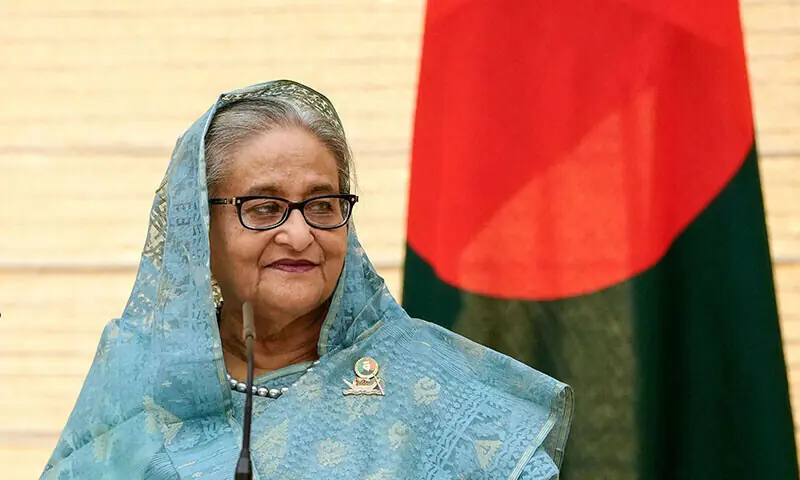
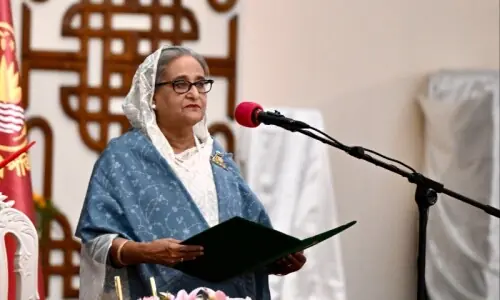
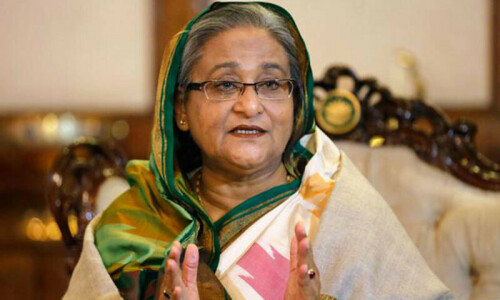
DHAKA: A commission set up to investigate a violent mutiny that saw dozens of senior army officers massacred 16 years ago on Sunday said former premier Sheikh Hasina had ordered the killings.
Rampaging troops from the Bangladesh Rifles (BDR) murdered 74 people, including military officers, during the two-day revolt that began in Dhaka and spread across the country in 2009, destabilising the government of then-premier Hasina weeks after she took office.
After Hasina was ousted last year following a student-led uprising, the interim government led by Muhammad Yunus formed a commission to investigate the incident.
Hasina, 78, has since sought refuge in India, defying court orders that she return to Bangladesh.
According to the commission’s report submitted on Sunday, the then-Awami League government led by Hasina was directly involved in the mutiny.
Former member of parliament Fazle Noor Taposh acted as the “principal coordinator” and at the behest of Hasina who gave the “green signal” to carry out the killings, the government’s press office said, quoting the commission chief, A.L.M. Fazlur Rahman.
“The involvement of a foreign force was strongly evident in the investigation,” the statement added.
At a news conference later in the day, Rahman accused India of trying to destabilise the country and “weaken the Bangladesh Army” following the carnage.
“There had been a conspiracy brewing for a long time to weaken Bangladesh’s forces,” Rahman said. There was no immediate response from India over the accusation.
India’s support for Hasina has frayed relations between the two neighbours since her overthrow.
Yunus welcomed the commission’s report, saying the nation had long remained in the dark about the reasons behind the 2009 killings. “Through the commission report, the truth has finally been revealed,” he said.
A previous investigation into the mutiny blamed years of pent-up anger among soldiers, who felt their appeals for pay rises and better treatment were ignored. But that probe was carried out during Hasina’s tenure, and her opponents claimed her involvement in a conspiracy to orchestrate the mutiny in order to weaken the military and bolster her own power.
Tarique Rahman says his return not in his hands
Bangladesh’s former prime minister Khaleda Zia remains in “very critical” condition at a Dhaka hospital, her party said on Sunday, as her self-exiled son and acting party chief Tarique Rahman signaled uncertainty over his return.
Khaleda, 80, who is the leader of the Bangladesh Nationalist Party, was admitted to a private hospital on Nov 23 with a severe chest infection affecting her heart and lungs, doctors and senior party officials said.
Her party has regained prominence after Sheikh Hasina, Bangladesh’s long-serving former prime minister, was ousted in a student-led uprising last year.
Rahman, who has lived in London since 2008, wrote on Facebook on Saturday that his return to Bangladesh was “not entirely” in his control, fuelling speculation over political or legal hurdles.
The interim government led by Nobel laureate Muhammad Yunus later said it had “no restrictions or objections” to his return. “There are no obstacles in this matter,” Yunus’ press secretary Shafiqul Alam said in a Facebook post.
The interim government will issue a travel pass within a day if Rahman wishes to return to Bangladesh, de facto Foreign Minister Touhid Hossain said on Sunday.
Rahman has been acquitted in all the cases against him since Hasina’s ouster in August last year, effectively removing the legal barriers that once complicated his return.
The Bangladesh Nationalist Party, which boycotted disputed elections in 2014 and 2024, has gained momentum since last August and is seen as a frontrunner in Bangladesh’s shifting political landscape.
Published in Dawn, December 1st, 2025