Saudi recognition of Israel hinges on Palestinian statehood, Washington analysts say
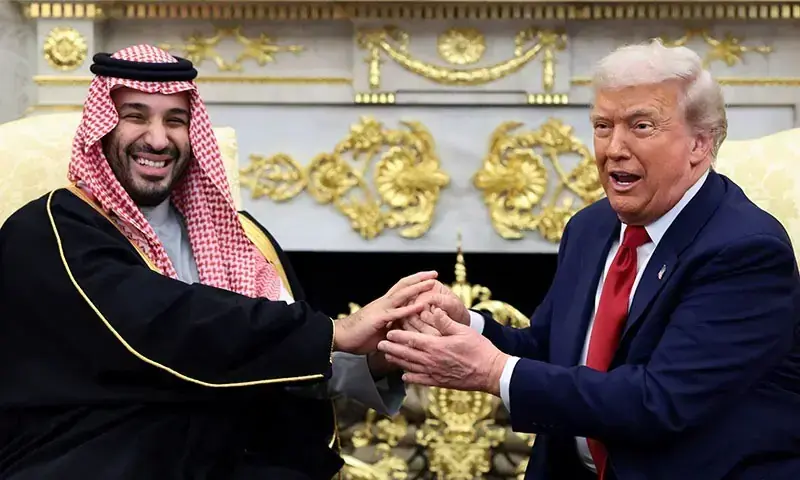


WASHINGTON: Will Saudi Arabia recognise Israel before Israel recognises a Palestinian state? That question was already being debated in Washington before Crown Prince Mohammed bin Salman (MBS) arrived earlier this week — and it continues even after his departure.
Many analysts argue that Saudi Arabia’s roadmap hinges on a firm commitment to Palestinian statehood.
“Saudi Arabia can’t go forward with normalisation without Israel in effect recognising the Palestinians have the right to a state,” said Hussein Ibish, senior resident scholar at the Arab Gulf States Institute in Washington, speaking to The New York Times.
MBS himself told President Trump during his visit: “We want to be part of the Abraham Accords. But we want also to be sure that we secure a clear path to a two-state solution.”
That insistence frames what many view as the red line in any potential Saudi-Israeli normalisation — not merely a diplomatic hurdle, but a condition tied to Riyadh’s regional standing and religious stature.
US reliability
The visit followed growing uncertainty in Saudi Arabia and among other US allies in the Middle East about the reliability of American security guarantees. In September, Israel attempted to assassinate senior Hamas officials in Qatar, rattling neighbouring Gulf states, particularly because Qatar’s close alliance with the United States did not prevent the operation.
“The Saudis worry about US reliability,” said F. Gregory Gause, professor of international affairs at Texas A&M University. He added that the agreements signed in Washington during the visit “are part of the way to keep us from leaving” Saudi Arabia exposed to a Qatar-like situation.
At a discussion hosted by the Middle East Institute in Washington, Prof Gause further explained how the turbulent regional landscape is shaping Riyadh’s foreign-policy calculations and why it seeks a bilateral defence agreement with the United States.
‘Too powerful to ignore’
Examining why MBS has returned to what it called “Washington’s embrace”, the NYT noted that the Saudi leader is now “too powerful to ignore”.
At 40, he has cemented his position “not only as the de facto ruler of Saudi Arabia but also as a global political heavyweight — a diplomatic deal-maker who oversees one of the world’s largest sovereign wealth funds”.
That mix of political clout and economic ambition shaped how Washington received the crown prince. Over the past decade, MBS has accelerated a sweeping social and economic reform agenda under Vision 2030, aiming to wean the kingdom off oil and build a diversified, globally competitive economy.
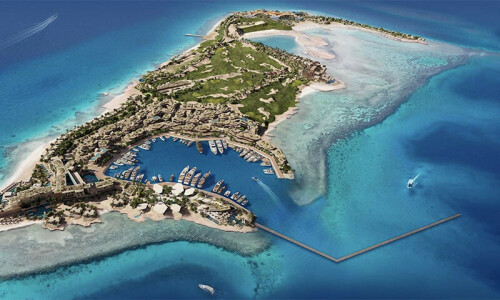
Megaprojects such as NEOM, The Line, and the Red Sea schemes are the visible manifestations of that strategy.
“MBS, too, is in a hurry. In the past decade, he has helped transform Saudi Arabia economically, socially, and politically, but he also realises the need to address some setbacks and lock in momentum for what’s ahead. His ambition is to transform his religiously conservative, oil-dependent kingdom into a diversified, globally connected power that will thrive long after hydrocarbons fade,” Frederick Kempe, president and chief executive officer of the Atlantic Council, said.
Kempe added a political dimension to that urgency: “Trump is a man in a hurry to leave a lasting foreign policy legacy,” noting that the Middle East remains one of the president’s most consequential opportunities.
Defence ties
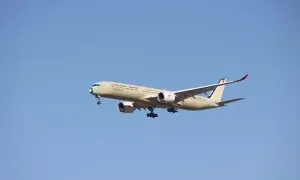
Defence cooperation was a central pillar of the visit. Daniel B. Shapiro, a former US ambassador to Israel and Atlantic Council scholar, stressed that Trump’s approval of F-35 fighter jets for Saudi Arabia signalled a deeper commitment: “Trump … is going all-in on the US-Saudi relationship.”
Yet the defence track is not without complications. “China remains an issue in the backdrop of US-Saudi defense relations,” Tressa Guvenov of the Atlantic Council warned. In a series statements released by the council, Guveniv noted that “similar efforts to sell F-35s to the UAE were not realized … in part due to concerns of technology transfer to China.”
US intelligence concerns over potential Chinese access to advanced systems continue to shape deliberations in Washington.
Shapiro also highlighted the need to preserve Israel’s qualitative military edge (QME). He noted that the UAE deal had passed a QME review and that the Saudi sale is likely to do so “because Israel will have been flying the F-35 for a decade and a half before the first Saudi plane is delivered, and Israel will have nearly seventy-five F-35s by then.” He added that, unlike past cases, “it appears there is no link to Saudi normalization” in this deal — and that MBS’s insistence on “a clear path” to a Palestinian state signals “a potential disparity from Saudi Arabia’s previous stance requiring the ‘establishment’ of a Palestinian state.”
Beyond security, the visit was also about investment. Washington is pressing Riyadh to nearly double Saudi US investments — particularly in AI, technology, and energy — with MBS positioning the kingdom’s sovereign wealth fund as the vehicle for that push. The IMF’s 2025 Article IV consultation praised Saudi Arabia’s “strong resilience to shocks,” noting expanding non-oil activity, contained inflation, and record-low unemployment, while urging continued structural reform to sustain growth.
For US policymakers, the payoff is clear: a Saudi partner that is economically strong, technologically advanced, and more disposed to diplomacy. For Riyadh, however, any march toward normalization will be measured against the litmus test MBS has set — Palestinian statehood.
Frederick Kempe summed up the political tempo: both leaders are racing to secure legacies. Trump seeks a foreign-policy signature; MBS seeks to lock in momentum for a transformed, globally connected Saudi Arabia that can thrive long after oil’s dominance fades.
Published in Dawn, November 22nd, 2025