Eyeing Russia, EU targets barriers to moving military eastward
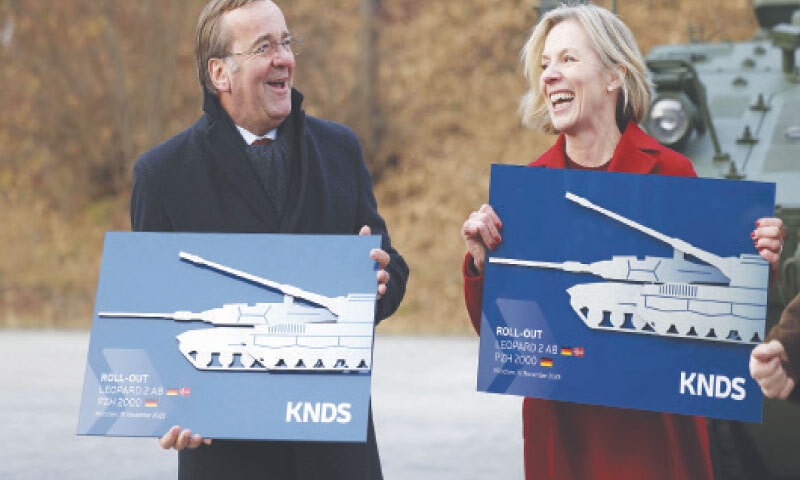

BRUSSELS: The EU on Wednesday took aim at the red tape and bottlenecks hampering the movement of tanks and troops across the continent as fears grow that conflict could one day erupt with Russia.
A European official summed up the challenge: how do you ensure a column of tanks stationed in Spain “doesn’t reach Poland after the war“?
For now, that is far from guaranteed.
Tanks and other heavy equipment currently require country-by-country authorisations to transit through European Union territory. Even with permits, convoys often have to take lengthy detours to avoid roads or bridges too weak to bear their weight.
“The fast movement of Europe’s militaries is essential for European defence,” EU foreign policy chief Kaja Kallas said. “We have to ensure that forces can be in the right place and at the right time.”
With Europe racing to build its defences since Russia’s 2022 invasion of Ukraine, EU auditors warned this year that moving troops and weapons across the 27-nation bloc remained “problematic” and that it was unclear “who does what”.
The European Court of Auditors called governance arrangements for military mobility in the EU “complex and fragmented” – noting for instance that tanks from one country cannot move through another if they are heavier than road traffic regulations allow.
One telling example: France encountered difficulties in 2022 transporting tanks to Romania after Germany said the heavy equipment could not travel by road. Officials had to charter trains.
Around 500 key choke points have been identified along potential corridors for troop movements through Europe in the event of war, as part of the commission’s plan.
Most need urgent upgrades to bring about the kind of mobility that has become a priority since Russia’s invasion of Ukraine.
Underscoring the need to act, EU defence commissioner Andrius Kubilius quoted the commander of US forces in Europe during World War I, General John J. Pershing, who famously declared: “Infantry wins battles; logistics wins wars.”
Stress tests
To tackle bottlenecks, the commission is proposing a single permit valid across the EU, replacing the current patchwork of authorisations — some of which must be requested 45 days in advance.
In emergencies, Brussels also wants clear rules for priority passage to avoid delays.
A so-called solidarity mechanism pooling national dual-use defence resources such as trucks for rapid access is also foreseen. Kubilius said the EU plans marked a “substantial step forward.”
To make sure the system works, the commission said regular “stress tests” would be carried out to check whether infrastructure can handle heavy military traffic.
Awareness of the problem is not new: NATO has been fretting about it for years and the commission has already launched two action plans, the latest in November 2022, which got a lacklustre reception from the Court of Auditors.
Brussels wants to earmark 17 billion euros ($19.7 billion) between 2028 and 2034 to boost military mobility – 10 times more than under its previous long-term budget.
The commission also on Wednesday unveiled moves to bring Europe’s defence industry closer to emerging technologies — from artificial intelligence to quantum computing and space systems.
While arms manufacturers already use these tools extensively, Brussels wants to encourage joint projects and is pushing in particular for the bloc’s emerging “AI factories” aimed at testing artificial intelligence solutions to be opened to defence firms.
Published in Dawn, November 20th, 2025