0
0


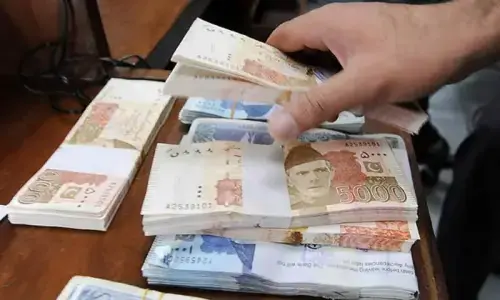
In July 2025, agents from a regulatory body raided the backroom of a cash-based business in Quetta. They were astounded to discover a miniature central bank containing Rs684,000, 230.5 million Iranian riyals, more than 135,000 Afghanis, $700, 200 Saudi riyals, and 150 Australian dollars; the drawers were spilling over with cash, reflecting the thriving hawala/hundi network.
Not so long ago, the Federal Investigation Agency raided a travel agency in Karachi and discovered an underground remittance ring that transferred money abroad through shell companies; it also seized Rs25m in cash and various valuables, such as computers, mobile phones, prize bonds, and checks. From border communities to the nation’s financial centre, these ‘spec-ops’ sort of raids reveal an open secret: despite years of regulation, Financial Action Task Force (FATF) inspections, and numerous ‘crackdowns’, Pakistan’s informal hawala economy continues to flourish.
Although Pakistan has officially adopted the FATF framework, unofficial money transfers continue. According to a 2015 State Bank of Pakistan (SBP) meeting, hawala payments had already topped $15 billion annually, accounting for a significant share of the year’s remittances.
The answer to the question ‘why does this issue persist?’ is simple: hawala provides speed, convenience, and trust, features that don’t often occur with formal mechanisms. Without completing any paperwork or paying any fees, a worker in Dubai can give cash to a hawaladar and have rupees sent to his family in a matter of hours.
Despite years of regulations, FATF inspections, and numerous crackdowns, Pakistan’s informal hawala economy continues to flourish
Moreover, millions of migrants and unbanked households rely more on hawala, as dealers offer better rates than banks when the rupee’s open-market rate diverges from the official interbank rate. These covert transactions circumvent the financial system, deprive Pakistan of foreign exchange reserves, and facilitate money laundering, tax evasion, and possibly terror financing. Therefore, policymakers must make the difficult decision to maintain citizen access while ensuring systemic responsibility.
Pakistan’s regulatory response has long varied between inventiveness and overreach. In response to criticism from the International Monetary Fund (IMF) and the FATF, especially FATF Special Recommendation VI, the SBP has focused on establishing exchange businesses since 2002 to integrate informal moneychangers into the mainstream financial system.
The Central Bank informed all hawaladars in 2004 to register as approved foreign exchange dealers and to indicate their intention to meet minimum capital requirements, in an attempt to bring them into conformity with the recommendations, including the FATF’s current ‘Recommendation 14’ requiring licensing of all Money or Value Transfer Services.
However, the strict standards continue to ignore small operators, which is why the majority of hawaladars can continue to use underground channels.
Also, without FATF’s recommendations, hawala was already banned in Pakistan. But appearing practically ineffective on the ground, the adoption of FATF-compliant laws seems performative, and is thus defined as a ‘compliance façade’.
Further reforms came, intending to strengthen enforcement. While the Foreign Exchange Regulation Act, 1947 (FERA) still prohibited improper remittances, the Anti-Money Laundering Act, 2010 made dealing in unlicensed currency a predicate offence for money-laundering charges.
Although few ever serve time, violators of Section 23 of FERA face up to five years in jail, but few have been imprisoned. Meanwhile, courts struggle to implement FERA. However, the real problem lies in enforcement, not the law.
So, why does every effort falter? First, rather than viewing hawala as a sign of exclusion, law enforcement agencies view it as a crime in and of itself, overlooking the masses’ access to the banking system. Remittances sent or received through a formal branch in rural areas may require lengthy travel, complex paperwork, or expensive transfer fees; in contrast, informal sellers deliver immediately from the closest market stand.
Second, the regulation unintentionally worsens the problem, as dealers are encouraged to operate through underground channels due to high license fees and stringent documentation requirements, which discourage small operators from registering.
Third, networks can reorganise more quickly than cases move through the courts due to judicial delays and poor cooperation among regulatory agencies.
Lastly, minimum capital requirements, as envisaged by the SBP, deter small dealers from complying due to increased costs, and resolving this issue remains a challenge as well.
If Pakistan is to address this issue, it must rethink its approach; the goal should be regulated inclusion rather than a blunt prohibition. Authorities can introduce a tiered licensing system in which small hawaladars who register, maintain basic transaction records, and comply with limits could operate legally under SBP supervision.
The government can also offer hawaladars who willingly join the official network temporary tax breaks or streamlined procedures, shielding them from arbitrary raids after registration. This way, the government may also take advantage of the hawala networks and generate a substantial revenue by making them transparent and then taxing them within a well-regulated system.
The writers are financial law students at LUMS
Published in Dawn, The Business and Finance Weekly, November 17th, 2025