0
0

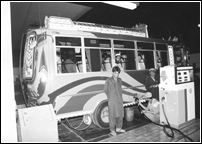 THE import bill of petroleum products rose by 64.46 per cent to $4.615 billion during the July-March period of the current fiscal year as against $2.806 billion during the same period last year.
In the nine months compared, the import of petroleum products recorded a growth of 53.44 per cent and petroleum crude a rise of 72.64 per cent. The trend is likely to continue as oil prices remain high.
It shows our addiction to the use of oil and our helplessness at the slow pace of exploration of new oil fields. In fact, oil exploration and production needs to be stepped up.
Oil is transforming world politics and the prices of petroleum products have a direct and deep impact on all sectors of the economy. Any abnormal price hike can bring untold sufferings to the middle class and particularly, to the low income groups.
Prices of petroleum products were being fixed by Oil Companies Advisory Committee (OCAC) on the basis of a formula approved by the government. The allegation against the Oil Companies Advisory Committee is that it has taken advantage of the official mandate.
According to the policy now in vogue, prices are fixed on fort-nightly basis. The price formula provides for administration expenses, transportation expenses, dealers commission etc on percentage basis. It is not possible for the costs to accelerate on fortnightly basis.
On the other hand, refineries, oil companies, dealers etc may not be prepared to review these costs downward when price of crude oil goes down in the international market. This may be the reason when in the past, in the case of decline in prices of crude oil in the international market, the retail prices of petroleum products have generally not been revised downwards and instead existing retail prices have been maintained.
It is understood that for arriving at the end prices, calculations are linked to US crude oil which is not imported in Pakistan. According to well established accounting principles, calculations for costing purposes are made for existing stocks at their actual purchase prices or market value, whichever is lower. There is no justification whatsoever for revising upward the value of existing stocks at each price hike. It is doubtful that in the case of decline of prices of crude oil in the international market, the oil companies and refineries revise the cost of existing stocks downward.
There is no competition among the oil companies in the case of primary products as uniform prices are being fixed for the whole of Pakistan for all the primary products. There may be some element of competition among the oil companies for the bi-products such as lubricants, asphalt etc. As such it would not be fair to include the administration and other costs relating to the bi-products in the price formula. For the bi-products, the market forces should determine the selling prices and oil companies would be well advised to set up separate market arrangements for their bi-products.
The government has also come in for criticism in this regard. It is being blamed for including tax and other levies, which account for a substantial share in the price hikes.
In the face of mounting criticism against the price hikes of petroleum products which have been too frequent, the government solicited a report from the World Bank in this matter. The report has since been received from the World Bank which is believed to have recommended a thorough investigation in this matter from a non-oil organisation. It is understood that the World Bank has also disputed some of the expenses claimed and paid to the Oil Companies Advisory Committee.
The government has also directed National Accountability Bureau (NAB) to look into the whole matter. This is also a welcome move. It is understood that Director General (Audit) of Pakistan is also seized of the matter. Furthermore, the apex court (Supreme Court) has shown concern in ever increasing petroleum prices and has commenced hearings of complaints lodged by concerned citizens with it.
Now the increase in prices is being effected through OGRA and in order to get positive results, OGRA needs to be revamped and strengthened with the induction of professionals.
The old pattern of fixation of petroleum prices has been followed in the new price hike also. The price of petrol for sale to car owners has been notified as Rs57.70 per litre. The writer has made two purchases from two petrol filling stations located in Clifton area of Karachi directly opposite to each other.
One petrol filling station has charged Rs57.79 per litre and the other has charged Rs57.80. If this is the situation in Clifton area of Karachi, what will be the situation like in the rest of the city and indeed throughout the country as the prices notified are for the whole of Pakistan.
It is not understood as to why petrol filling stations or other dealers handling the sale of petroleum products recover any extra charges over and above the prices notified by the government. Somewhere the governance is missing. There is need to ensure that only the prices notified in the media are charged from all customers and no extra charges are recovered. The price formula under which the prices are being fixed at present and are being notified needs careful examination as already suggested.
It has also been noted that in the case of petrol the government places a development surcharge, sales tax, excise duty and inland equalization surcharge which all add up to Rs24 per litre. This means that over 40 per cent of the price of a litre of petrol that the consumer pays goes into the government’s coffers. Government levies may vary in other products.
The diesel prices have gone up by 5.5 per cent. Kerosene oil saw the highest increase 7.2 per cent. One would have wished that any price increase in kerosene oil could have been avoided as it is consumed by the poorest segment of our population, which has no access to electricity.
Henry Kissinger thinks that the 21st century struggle for oil reserves will match the 19th century struggle for colonies. Dangers are obvious.
For alternates to oil, Brazil has already shown the way. It is now claiming that its ethanol production in the sugar industry serves 75 per cent car population of Brazil after minor alterations in the engine.
The question arises as to what Pakistan is doing with a booming sugar industry, to get out of its strong addiction of oil. Some of our sugar mills have already installed distilleries for production of ethanol but this capacity is lying unutilized as molasses, the basic raw material, needed for production of ethanol, is being exported freely.
We need to develop a new culture of research embracing all sectors of our economy. In the past numerous research organisations were set up which now appear to be lying dormant. We need to reactivate and revamp the old institutions and set up new institutions where considered necessary. Adequate funds should be provided for this purpose.
Universities should also be targeted for research and development. In view of the emerging oil crises, top priority needs to be given to finding alternates to oil.