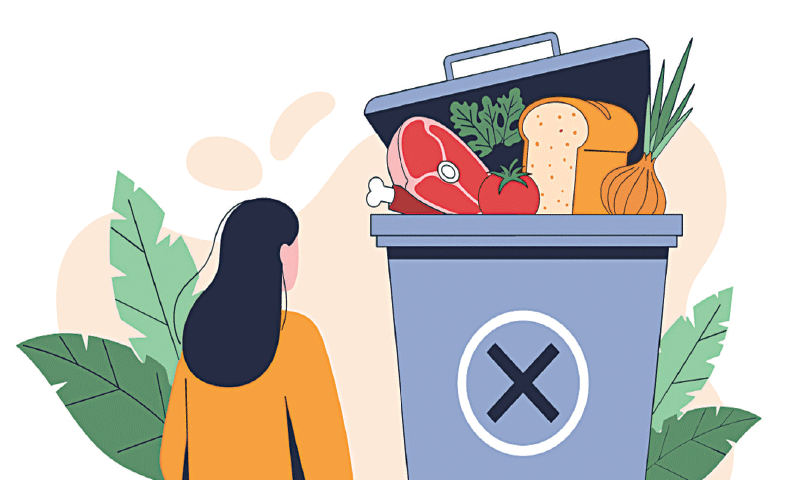

Our kitchen waste can power our stoves — if we stop treating it as garbage. In Karachi, the cool weather does not last long in winter, but gas load shedding continues well into April. Karachiites know well the sputtering flame that dies mid-meal, gas pressure falling to a whisper, and families waiting for hours for a kettle to boil.
Gas load-shedding has quietly reshaped daily life. Families switch to LPG cylinders or to highly dangerous gas pressure machines (affecting the equity of gas access). The gas cylinders we use have no safety standards — no valves, no gauges, not even a simple way to know when they’re about to run out. They’ve become a fixture everywhere, from tiny apartment kitchens to high-end homes, posing the same quiet risk across the city.
For many lower-income households, wood, coal, and makeshift stoves remain their only options. In a city this vast, this vulnerable, the question persists: can there be a safer, local source of fuel?
Waste as fuel
Karachi generates nearly 16,000 tons of waste every day, according to the Sindh Solid Waste Management Board. Roughly 54 per cent of this waste is organic, which is the everyday mix of kitchen scraps, fruit peels, and leftover food that simply rots away in landfills. When it breaks down, methane is released into the air, which is needed in our pipelines.
Across the border in India, a small biogas unit has been designed that runs entirely on food waste by the Appropriate Rural Technology Institute (ARTI). These are compact digesters, about 1–2 m³ in size, and are small enough to fit on a rooftop or corner of a backyard, turning waste into clean usable fuel.
In urban areas of Nepal, many households have adopted household digesters to power their kitchens, reducing the use of imported LPG. The lesson is simple: we can use our kitchen waste to keep our stoves burning as a supplementary source.
Many cities in India have adopted this low-tech, high-impact idea; for example, a housing society in Pune processes one ton of kitchen waste daily through a small digester to light its streets and power the communal gym, saving on power costs.
Another example is in Ahmedabad, where the housing byelaws require large societies to process organic waste on-site, leading to the installation of biogas units on the roofs of apartment towers and in shared courtyards. At the municipal level, Indore uses segregated household waste to feed CNG plants that collectively replace diesel for city buses.
These models indicate that urban biogas can thrive not only in large institutions or farms but also in regular neighbourhoods and apartment complexes, much like Karachi’s many housing developments.
Powering Karachi’s homes
Karachi’s residential fabric is diverse, and so are the opportunities.
In bungalows in middle-income localities like Gulistan-e-Jauhar, North Nazimabad, and FB Area, a 1–2 m³ plant can easily be hosted beside the water tank or in the backyard. The ARTI model produces 2–3 m³ of biogas daily, roughly equivalent to a single LPG cylinder per week, which is sufficient for a family. The leftover slurry can be used in compost for garden plants.
In upper-middle- and high-income homes in DHA, PECHS, etc., where multiple kitchens are operational, a larger 3–4 m³ underground digester should be installed and connected to the kitchen and generator.
In large apartment buildings, a communal digester of 8–10 m³ can power a standby generator or serve as a supplementary stove per flat. In Pune, a similar installation serves 48 flats fully maintained by residents’ funds in the Vishrantwadi block, with the compost distributed among the members.
Apartment buildings from Gulshan to Clifton can adopt this cooperative model in mid-rise apartment buildings. This model could also greatly decrease the pressure on the Sindh Solid Waste Management Board.
Waste management
Beyond cooking, biogas can help reshape Karachi’s waste story. The UN Economic and Social Commission for Asia and Pacific (2013) study and SWITCH Circular Economy (2023) report both identify organic waste as the single largest and least managed portion of municipal garbage.
If even 10pc of Karachi’s households processed their food waste in their homes, landfill loads would drop by over 1,000 tonnes daily. Each small digester diverts waste from the truck, prevents methane from open dumps, and provides nutrient-rich compost for domestic use and fuel for cooking.
Pakistan already has the regulatory base for this shift. Sindh Environmental Protection Agency’s 2020 Waste-to-Energy rules exempt biogas plants below 1MW from full environmental impact assessment, making small rooftop or courtyard units legally simple.
The National Energy Efficiency and Conservation Authority allows 30pc capital grants for renewable installations, which could be extended to biogas through municipal partnerships. If housing societies and architects treat biogas digesters like solar panels, as a standard fixture, Karachi could pioneer decentralised waste-to-energy systems in South Asia.
A sustainable flame
A small-sized digester for a household can start production within two to four weeks after installation. Initially, anaerobic bacteria naturally occurring in food waste, when mixed with water, multiply and produce methane. Adding a starter slurry, such as cow dung or from an existing digester, can speed up the process. Karachi’s 10-month-long summer is ideal for this purpose. This model can start producing gas in 18 to 25 days, and once it stabilises, regular feeding of 2-3 kg of kitchen waste can yield one to two hours of cooking gas per day, with no safety risk of pressure build-up.
When gas pressure drops, most of us reach for a cylinder. But there is another option, which is quieter, local, and regenerative. While the city debates megaprojects and mega-plants, in a two-square-metre tank turning yesterday’s scraps into tomorrow’s flame.
The writer is an architect and urban planner, currently leading her own practice, “Beyond Facades”
Published in Dawn, The Business and Finance Weekly, November 10th, 2025