KARACHI: Sindh Chief Minister Syed Murad Ali Shah on Thursday launched the Student Attendance Monitoring and Redress System (SAMRS), describing it as a “pioneering, transformative, and nationally replicable model” that puts technology and evidence-based planning at the core of education reform.
Speaking at the provincial launch ceremony held at a local hotel, the chief minister said SAMRS marked the first time that Sindh—or any province in Pakistan—had introduced an integrated digital platform linking student attendance, school infrastructure, teacher performance, and learning outcomes.
“This is not just a monitoring tool. It is a system that allows us to make decisions grounded in data rather than assumptions. It provides the clarity to identify the challenges our children face and the ability to respond quickly and effectively,” he said.
CM Murad says system will help reduce absenteeism; calls it ‘nationally replicable model’ to identify challenges facing students
The ceremony was attended by Education Minister Syed Sardar Shah, the World Bank Country Director Bolormaa Amgaabazar, senior representatives of the United Nations International Children’s Emergency Fund (Unicef), the Global Partnership for Education (GPE), Asian Development Bank (ADB), British Council, the Japan International Cooperation Agency (Jica), officials of the School Education and Literacy Department (SELD), education experts and development partners.
‘A model for Pakistan’
The chief minister emphasised that SAMRS had already gone live in 600 schools across 12 districts, with expansion in progress in four more districts through a Unicef-supported initiative. He stated that the system was designed not only to track absenteeism but also to predict dropout risks, suggest interventions, and enhance overall school management.
“SAMRS is a model that Pakistan can follow,” he said. “We are institutionalising it through a new policy that ensures long-term sustainability, ownership, and integration with Sindh’s education governance framework.”
He expressed gratitude to the World Bank, GPE, and all development partners for their “trust, technical guidance, and unwavering support” in strengthening public education in Sindh. The CM also praised the School Education Department, the Reform Support Unit (RSU), and the Sindh Early Learning Enhancement through Classroom Transformation (SELECT) project team for their “innovation, dedication, and perseverance.”
Multi-sector vision for child well-being
CM Shah highlighted the importance of linking education with health, nutrition, and child protection, urging partners to explore the integration of SAMRS with child immunisation programs, health screenings, and social safety systems.
“Schools must be more than classrooms,” he said. “They must become centres of child well-being and community trust.”
Minister praises ‘landmark achievement’
In his address, Education Minister Syed Sardar Shah called SAMRS a “game-changer,” constructing a digital ecosystem where attendance, performance, and school infrastructure data come together to guide decisions.
“With support from the National Database and Registration Authority, student identities are now shifting from system-generated IDs to verified B-Form numbers, ensuring every child in Sindh is counted and supported,” he said.
He noted that 99 per cent of schools using SAMRS reported attendance, and 92pc implemented redress procedures, a significant step toward reducing dropouts.
World Bank Country Director Bolormaa Amgaabazar, on the occasion, stated that SAMRS was not a donor-driven project but was planned by the Sindh government. “It is not a student’s attendance system, but it is a commitment of the provincial government to improve education.”
SELECT project
The chief minister also highlighted the broader SELECT Project, funded by the World Bank and GPE, focusing on improving early-grade literacy, transforming teaching practices, developing climate-resilient school infrastructure, and increasing student retention through SAMRS and capacity-building initiatives.
The $154.7 million programme covers 12 districts and aims to reduce learning poverty and promote school attendance, especially among girls.
The government announced plans to expand SAMRS province-wide via a structured training cascade beginning with master trainers and extending to cluster heads and all satellite schools.
“This is how we turn innovation into a legacy,” the CM said.
Mr Shah reaffirmed that every reform undertaken by the Sindh government, from technological systems to infrastructure projects, is aimed at “ensuring no child is left behind.”
“Our commitment to the children of Sindh is unwavering,” he said. “Every child deserves to be present, engaged, and thriving. This is the future we are building together.”
The launch ceremony concluded with a renewed pledge by the provincial government, development partners, and education stakeholders to strengthen education governance and deliver a modern, equitable, and technology-driven school system across Sindh.
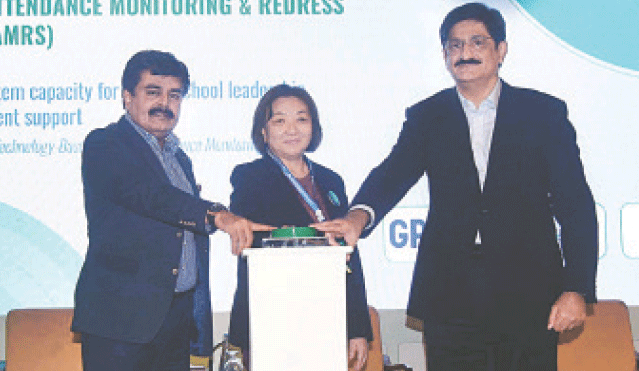
Earlier, the chief minister, accompanied by the education minister, and Ms Amgaabazar, officially launched the SAMRS by clicking the computer button.
Published in Dawn, November 7th, 2025