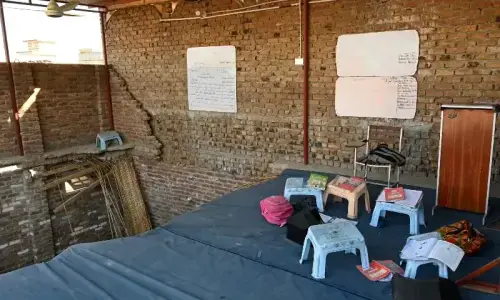
THE well-publicised massacres in El-Fasher over the 10 days since the Rapid Support Forces (RSF) captured the city after a nearly year-long siege have revived international interest in the Sudanese conflict, albeit without any obvious efforts to halt the horrendous bloodshed.
Donald Trump has threatened that US forces might enter Nigeria with “guns a-blazing” to tackle “the terrorist thugs” attacking “our CHERISHED Christians”. Like far too many other countries on the African continent, Nigeria does indeed experience atrocities perpetrated by the likes of Boko Haram, but it’s not just Christians who are terrorised. Besides, as the US president may or (more likely) may not be aware, decades of US military involvement across Africa has failed to substantially tackle the nefarious activities of Al Qaeda affiliates and offshoots.
The focus on a particular religion reflects the narrowness of Trump’s mentality — or perhaps his mendacity, given he never expressed any concern about the Christians lives lost, or at risk, in Gaza. And while concerns about Nigeria are all very well, it’s far from being Africa’s most concerning trouble spot. That qualification belongs to Sudan, which has been embroiled in various forms of strife pretty much since it won independence from British colonialism in 1956. But nothing in its recent past matches the level of violence it has suffered since a popular uprising toppled its military dictator seven years ago.
Omar al-Bashir had been in power since 1989 and, among other crimes, deserves to face justice for the Darfur genocide of 2003, when the state-sponsored Janjaweed militia was unleashed against the region’s non-Arab inhabitants. Under the leadership of an exceptionally vicious warlord — Mohamed Hamdan Dagalo, aka Hemedti — it eventually evolved into the RSF, and initially shared power with the Sudanese Armed Forces (SAF) after a military coup in 2021 overthrew the semi-civilian post-Bashir arrangement that was supposedly intended to lead to some form of democracy.
All hell broke loose following a 2023 falling-out between the RSF and SAF, with Khartoum among the targets of the former’s wrath. Since then, both sides have violated human rights to varying degrees. Over the years, they have also acquired regional allies that serve as conduits for weaponry and diplomatic support.
The RSF is said to be particularly reliant on the UAE, which has supplied weapons from sources such as the UK and China, as well as mercenaries from Colombia. The relationship stretches back to the years when the RSF sent troops to aid the Saudi-Emirati military assault against Yemen. Abu Dhabi isn’t just returning the favour. Its interests include a steady flow of gold from Sudanese mines, as well as access to fertile food-growing terrains and control over Red Sea ports. The first of these is already paying dividends.
Sudan’s nightmare seems endless.
The Emiratis are also reportedly acquiring ports and islands off the Yemeni coast in collaboration with Israel to enhance their regional hegemony, as well as using their clients in Libya and Somalia to support their proxies in Sudan. But, to be fair, the SAF enjoys the backing of the UAE’s regional rivals such as the Saudis, Qatar, Egypt and Turkiye. China, Russia and even Ukraine would also find it hard to wash their hands clean of the compounding mess in Sudan.
One can only wonder, yet again, what the so-called international community is worth if it cannot halt genocides. The one launched in Gaza in October 2023 has at least temporarily been stalled, albeit unconvincingly, and even though the primary perpetrator clearly has other intentions. The mass killings in Sudan can only be paused, and perhaps even halted, if the chief sponsors reconsider their patronage. The sheikhs often tend to cave in if the pressure comes from an indispensable ally, although it might take more than a stern word to fully grasp that propping up Haftar or Hemedti is not in their best interests.
No one should be under any illusion, though, that persuading the UAE somehow to retract its vital backing for perhaps the vilest protagonist would serve as a panacea for Sudan. Besides, it’s useful to remember that beyond the continent’s third largest country, the 21st-century scramble for Africa continues apace, and neither the former colonial or neocolonial powers nor the novice would-be hegemons in the Gulf and beyond intend to relent anytime soon. In Gaza and far beyond, the victims don’t count for much. Whether the future can be any different from the present and past remains to be seen.
Published in Dawn, November 5th, 2025