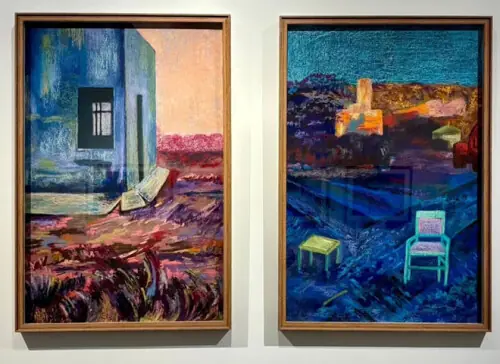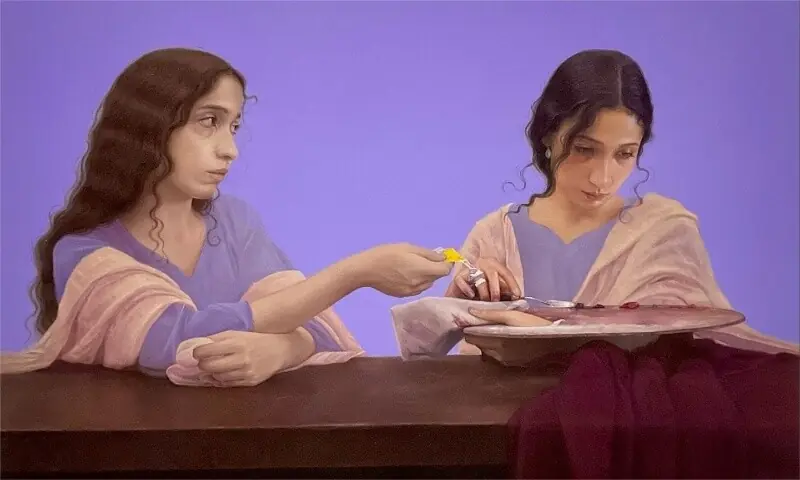


At Karachi’s Sanat Initiative, ‘Between Holding and Letting Go’, Zarnaab Baloch’s debut solo exhibition, unfolded like an intimate diary written in paint — deeply personal, yet resonant with collective emotion.
A resident of Lyari and perhaps the first woman artist from the Baloch community to have a solo show, Zarnaab’s emergence feels both historic and profoundly poetic. Her self-portraits are no less than those of a master — precise, powerful and layered with meaning far beyond their apparent stillness.
Zarnaab graduated only two years ago from the Arts Council Institute of Arts and Crafts (ACIAC), formerly the Central Institute of Arts and Crafts, from where I also graduated in the early 1970s. It is deeply moving to see a new generation of artists from the same institution pushing the boundaries of introspection and identity in such fearless, sophisticated ways.
For Zarnaab, self-portraiture is a form of dialogue and disclosure. “For me, self-portraits are a way of forming a deep connection with the audience,” she says. “My self-depiction within my paintings speaks on my behalf, creating a vulnerable yet mysterious bond between the viewer and the work. A quiet gaze or a subtle discomfort in my expression draws the viewer in — often leading them back to reflect upon their own inner selves.”
The self-portraits that Zarnaab Baloch paints are not an exercise in vanity — they are explorations of pain, endurance and selfhood
Indeed, her self-portraits achieve precisely that. Each painting feels like an encounter with a mind unafraid of its own complexity. Her eyes do not merely look outward — they seem to turn inward, questioning, probing, unearthing. There is something of Frida Kahlo’s spirit here — not in imitation, but in kinship. Like Kahlo, Zarnaab uses her own image not as narcissism but as necessity to explore pain, endurance and selfhood from within. Both artists transform the personal into the universal, revealing strength through vulnerability.
Two of Zarnaab’s striking works feature oleander flowers, with which she envelops herself. The blossoms rendered in soft pinks and creamy whites against muted backgrounds appear lush, abundant and delicately painted. Yet, oleander, as we know, is poisonous. In Zarnaab’s hands, this duality becomes a potent metaphor.
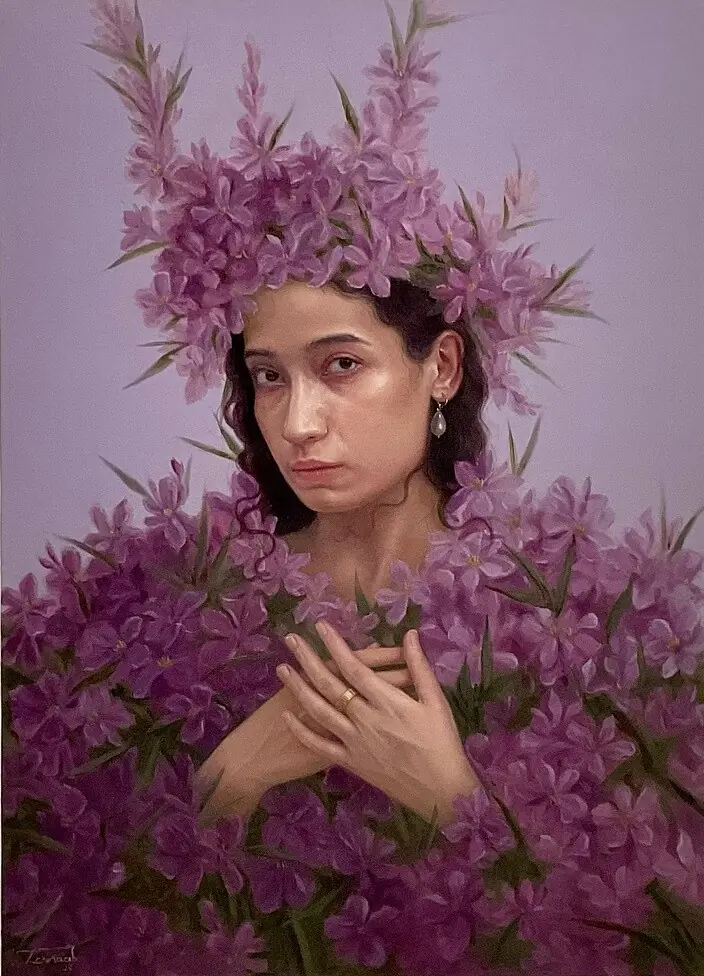
The flowers conceal her body, suggesting modesty or protection, but their toxicity also implies danger and resistance. To wear them is to carry both beauty and warning. They beautify, but they also suffocate — an embodiment of how women navigate tenderness and peril in the same breath. The artist’s gaze, half-shielded yet unwavering, makes these compositions unforgettable.
Another painting presents her seated against a dusky backdrop, the skin luminous and alive under a thin veil of shadow. The light caresses her features without sentimentality. There is no overt drama, only a quiet, controlled melancholy. The effect recalls the stillness of a photograph, yet the paint gives it breath. Here, Zarnaab’s mastery of form and tone rivals far more seasoned artists. Her palette is restrained: ochres, faded rose, umber and ash — a muted symphony that amplifies rather than dulls emotion. Each brushstroke feels deliberate — her surfaces are clean but never cold. This precision allows her to balance fragility with strength, an equilibrium that is at the heart of her practice.
Coming from Lyari, a neighbourhood so often stereotyped in narrow, negative terms, Zarnaab reclaims her own narrative through paint. Her works do not announce rebellion — instead, they whisper it with quiet determination. They speak of a woman who has learned to see herself clearly and, through that gaze, invites others to see beyond assumptions.
What stands out most in ‘Between Holding and Letting Go’ is the maturity of vision. Zarnaab paints not as a newcomer but as someone who already understands the weight of her voice. Her mastery lies in knowing when to reveal and when to withhold, when to let the gaze linger, when to turn it inward again.
In this extraordinary show, Zarnaab reminds us that self-portraiture, when done with honesty and depth, is an act of courage. Her paintings carry the quiet strength of someone who has dared to see herself fully in beauty and in pain, in holding and in letting go. Like Frida Kahlo’s work, Zarnaab’s self-portraits are not simply mirrors — they are mirrors that burn, converting the reflection into passion, pain, intensity and into something alive and transformative.
‘Between Holding and Letting Go’ was on display at the Sanat Initiative in Karachi from October 2-16, 2025
Rumana Husain is a writer, artist and educator. She is the author of two coffee-table books on Karachi, and has authored and illustrated 90 children’s books
Published in Dawn, EOS, November 2nd, 2025