Nearly 700 people, including Pakistanis, flee to Thailand after Myanmar scam centre raid
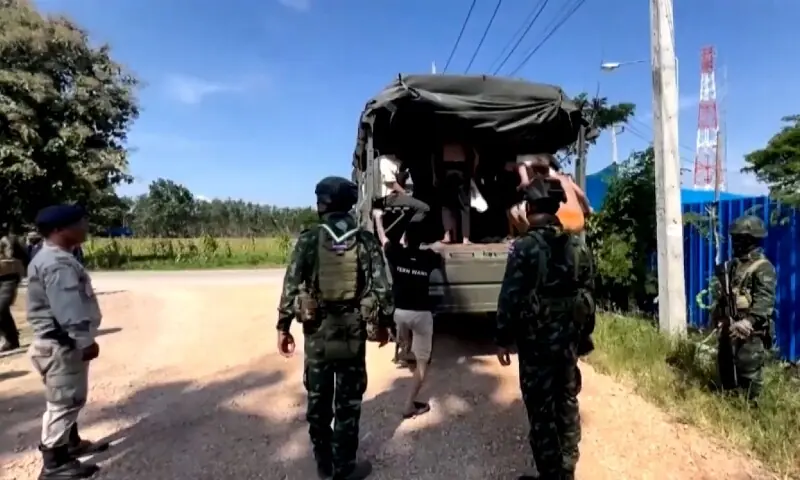

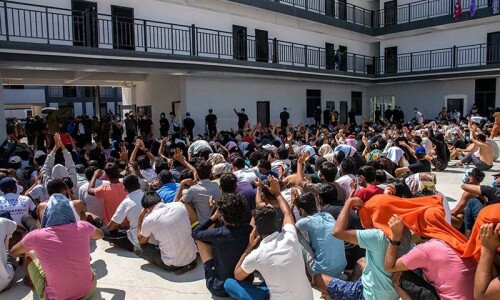
Nearly 700 foreigners, including Pakistanis, have fled Myanmar and crossed into Thailand, the Thai army said on Thursday, following a military operation against the Chinese-backed KK Park, a notorious cybercrime compound.
Thailand has detained 677 people, including 618 men and 59 women, after they crossed the border into Tak province, it said in a statement.
Myanmar’s military has taken control of KK Park and is inspecting the area, driving a large number of people into Thailand, the statement said.
The people are now undergoing legal procedures and screening, and Thai authorities have also made additional detention facilities available in case existing spaces become insufficient, the army said.
“All actions are in line with legal and humanitarian principles,” it said, adding that it was working closely with local security agencies to maintain order along the Thai-Myanmar border.
The group consists primarily of individuals from India and China, with smaller numbers from Vietnam, Pakistan, Indonesia and several other countries, the army said.
Myanmar’s KK Park is a notorious enclave known to international law enforcement and diplomats for its involvement in cyberscams.
KK Park’s sprawling compound and others nearby are run primarily by Chinese criminal gangs and guarded by local militia groups aligned to Myanmar’s military.
Border areas between Thailand, Myanmar, Laos and Cambodia have become hubs for online fraud since the Covid-19 pandemic, and the United Nations says billions of dollars have been earned from the trafficking of hundreds of thousands of people forced to work in scam compounds.
The sprawling compounds, where internet fraudsters target people with romance and business cons, have thrived along Myanmar’s loosely governed border during its civil war, sparked by a 2021 coup.
A highly publicised crackdown starting in February saw around 7,000 workers repatriated and Thailand enact a cross-border internet blockade.
But an AFP investigation this month revealed construction has continued apace at several compounds, while Starlink internet service receivers have been installed en masse, seeming to connect the hubs to the Elon Musk-owned satellite network.
Sawanit Suriyakul Na Ayutthaya, deputy governor of Tak province on the Myanmar border, told AFP that “677 people fled from the scam centre“ across the Moei river into Thailand as of Thursday morning.
Another crowd of more than 100 people gathered on the Myanmar side of the main local border crossing to Thailand early Thursday, an AFP journalist saw, many carrying large suitcases and backpacks.
A driver in the area, speaking anonymously for security reasons, estimated 700 people had made illegal overnight crossings.
While some scam workers are clearly trafficked into often fortified compounds, experts say others go voluntarily with hopes of earning more in the multibillion-dollar illicit industry than they can at home.
Sawanit said immigration police and the military had provided assistance “under humanitarian procedures”.
Those who crossed “will undergo screening” to determine whether they have been victims of human trafficking or if they may be prosecuted for crossing the border illegally, he said.
The Tak Provincial Administration office, which oversees the area, said in a statement that the group entering from Myanmar comprised “foreign nationals” — both men and women — and authorities expected more to cross into Thailand.
Indonesian state news agency Antara reported around 20 Indonesians had “successfully crossed into Thai territory via the Moei River” as of Wednesday evening, according to the Indonesian embassy in Yangon, which cited Thai authorities.
Conned out of billions
Experts say Myanmar’s military has long turned a blind eye to scam centres which profit its militia allies, crucial collaborators in their fight against rebels.
The junta has also faced pressure to shut down scam operations from its military backer China, irked at the number of its citizens both participating in and being targeted by the scams.
But military crackdowns on scam hubs are likely token efforts organised in cahoots with allied militias in an attempt to appease China without badly denting profits, analysts say.
“Because of the news it became a need for our organisation to resolve it carefully,” said Saw Tin Win, a senior figure in the most powerful local militia.
“There is pressure from the military, so we warned people not to continue bad things,” he added, a Myanmar media outlet reported on Wednesday evening.
The transnational scam industry has ballooned in Southeast Asia in recent years, with thousands of scammers estimated to be involved.
Victims in the wider region were conned out of up to $37bn in 2023, according to a UN report, which said global losses were likely “much larger”.
Thailand’s Anti-Money Laundering Office seized assets worth 70 million baht ($2.1m) from Cambodian senator and tycoon Ly Yong Phat as part of an investigation into scam centres and his businesses, a senior police official told local media on Wednesday.
The US government sanctioned Ly Yong Phat last year for alleged abuses related to human trafficking in scam centres.
Thailand’s deputy finance minister Vorapak Tanyawong resigned on Wednesday following allegations linking him to Cambodian cyberscam operations.
Cambodian authorities said today they arrested 57 South Koreans for alleged involvement in cyberscams, as well as 29 Chinese nationals in the capital Phnom Penh — adding to 64 South Koreans deported last week for alleged links to the fraud networks.