0
0

WITH at least three major cross-border clashes within a week, there is an urgent need to address the core issues affecting Pak-Afghan ties, and prevent the situation from transforming into a full-blown conflict.
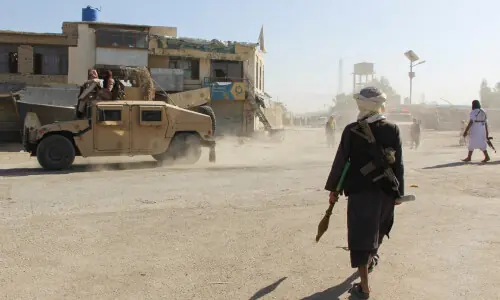
Though a temporary truce was reached on Wednesday, and the prime minister indicated yesterday that Islamabad was ready to talk if Kabul met certain conditions, there had been fierce fighting earlier when the Afghan Taliban launched an attack on the Chaman border. Pakistan hit back, targeting camps in Kandahar used by TTP terrorists, as per the military. Explosions were also heard in Kabul.
Earlier in the week, there were similar exchanges at Kurram, after the Taliban attacked Pakistani positions on Oct 11. Before the outbreak of hostilities, explosions were heard in Kabul last week, in which the TTP chief was reportedly targeted. Pakistan has not officially acknowledged this operation.
While the nation must be defended against foreign aggression, a long-term conflict against Afghanistan should be eschewed. These hostilities have occurred at a time when the Afghan Taliban foreign minister was touring India. In a display of diplomatic theatre, India, which does not recognise the Kabul regime, gave a rousing welcome to the Taliban delegation.
This is quite a turnaround for New Delhi, which had previously demonised the Taliban, and financially and diplomatically supported their Afghan rivals. In fact, after the Taliban retook Kabul in 2021, Narendra Modi reminded the UN that Afghanistan must “not be used to spread terrorism”. Now that anti-Pakistan terrorists have found sanctuary in Kabul, India seems to have forgotten these concerns.
Therefore, Pakistan must act with sagacity. The eastern border is already hot, and further adventurism from New Delhi cannot be ruled out. Hence, a conflict with the Afghan Taliban will only benefit India.
For Pakistan, the best option in these difficult circumstances appears to be to coordinate a response with regional allies, including China. For one, Muslim states, such as Saudi Arabia and Qatar, have been instrumental in brokering truces. These channels need to be kept open.
Moreover, at the recent Moscow Format Consultations on Afghanistan, in which both Pakistan and Kabul’s representatives participated, it was declared that Afghan soil cannot be “used as a threat to the security of neighbouring countries and beyond”. Pakistan faces a grave threat to its security from TTP terrorists who have found a sanctuary in Afghanistan. The UN, too, has endorsed Pakistan’s concerns, saying that the Taliban provide the TTP with “logistical and operational space”, while also providing training sites for Al Qaeda.
A regional meeting of states should be organised, where Pakistan should present these proofs, and the Afghan side should be asked to clarify. What is beyond doubt is that unless the threat of terrorist groups present in Afghanistan is addressed, the whole region will suffer, not just Pakistan.
Published in Dawn, October 17th, 2025