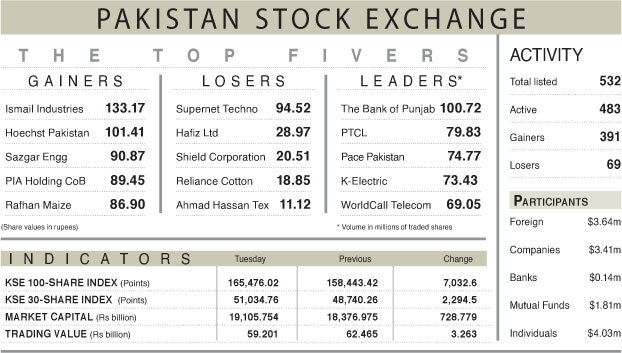
KARACHI: The Pakistan Stock Exchange (PSX) staged a strong recovery on Tuesday, as the benchmark KSE-100 index posted its second-highest single-session gain in history, driven by easing border tensions with Afghanistan and improving investor sentiment. The index surged by 7,032.60 points, or 4.44pc, to close at 165,476.02. This gain marks the second-largest absolute increase in a day, with the top three surges all occurring within the past six months, signalling sustained optimism among investors.
The market’s rally followed a steep decline over the previous six sessions, fuelled by concerns over stalled talks between Pakistan and the International Monetary Fund (IMF) regarding the $7bn Extended Fund Facility (EFF). However, Finance Minister Muhammad Aurangzeb expressed confidence on Tuesday that the staff-level agreement (SLA) would be signed this week, following positive discussions in Washington.
The recovery was further bolstered by the easing of domestic political tensions after a violent protest by the Tehreek-i-Labbaik Pakistan (TLP) was successfully dispersed, bringing much-needed stability to the market. Geopolitical sentiment also improved following positive comments from US President Donald Trump about Pakistan, which raised expectations for better diplomatic relations and renewed foreign investment.
Blue-chip stocks, including Lucky Cement, United Bank, Systems Ltd, Engro Corporation, Hub Power, and Mari Energies, led the rally, contributing a combined 2,645 points to the index’s gain. However, despite the sharp rebound, investor participation remained relatively weak. Trading volume fell by 13.59pc to 1.176bn shares, and the traded value dropped by 5.22pc to Rs59.2bn. Bank of Punjab emerged as the volume leader, with 100 million shares changing hands.
Positive domestic and geopolitical developments fuel market recovery
Ali Najib, Deputy Head of Trading at Arif Habib Ltd, pointed out that the market’s recovery came after a correction of nearly 9.3pc, or 12,310 points, over the previous seven sessions. He attributed the rebound to the calming of domestic political unrest and a reduction in global geopolitical risks, particularly following the signing of a peace accord that led to a decline in international oil prices. As a net oil importer, Pakistan stands to benefit from these lower prices, which will further boost market sentiment.
As the bulls regained control, attention now shifts to the KSE-100 index’s intraday all-time high of 169,988, reached on Oct 3. This remains a key resistance level, and analysts will closely monitor whether the market can sustain its momentum and break through this threshold.
The KSE-100 index has now returned to a consolidation band between 165,000 and 170,000 points, a crucial range that will likely determine the market’s direction in the coming days.However, concerns remain over the economic outlook, with rising inflation driven by flood-related disruptions and a slowdown in private sector activity. The first quarter of FY26 ended without any new borrowing by the private sector, reflecting weak economic activity nationwide. In fact, the private sector retired Rs297bn in debt during the July-September period, compared to Rs18.5bn in the same period last year, highlighting a decline in economic expansion.
Published in Dawn, October 15th, 2025