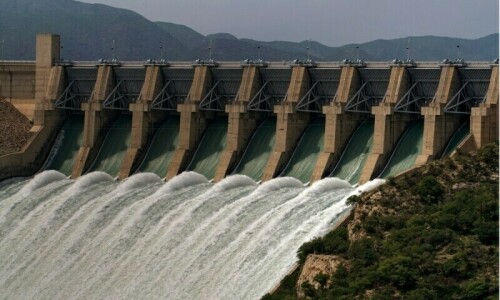
• With water levels at 10-year high, Irsa refuses to waste supply amid Wapda’s unresolved tunnel deadlines
ISLAMABAD: With water levels at their highest in a decade and shortages at their lowest in 33 years, the Indus River System Authority (Irsa) has unanimously rejected a request by Wapda to release almost half of Tarbela’s storage within a month and to extend deadlines for completing two tunnels.
At a meeting of the Irsa Advisory Committee (IAC) on Tuesday, the regulator expressed strong displeasure over delays in Tunnel5 (T5) and Tunnel4 Low Level Outlet (T4 LLO), and resolved to escalate the matter to the Ministry of Water Resources and the Prime Minister’s Office.
According to sources at the meeting, chaired by Irsa Chairman Sahibzada Muhammad Shabbir, Wapda’s delegation had proposed lowering Tarbela’s reservoir from its current peak of 1,550 feet to 1,495 feet by November 10, and requested additional construction time — eight months for one tunnel and a year for the other. The contract deadlines for both tunnels had already lapsed: one by roughly 33 months, and the other by three years.
Irsa members from Sindh and Punjab strongly opposed the proposal. They rejected discharging 2.8 million acrefeet (MAF) of water into the sea when there was no irrigation demand. The committee argued that Pakistan’s agricultural output should not be held hostage to Wapda’s delays, warning that such deep drawdowns could jeopardise the Rabi season and reduce carryover for Kharif 2026.
Committee members observed that T4, its LLO, and T5 should have been completed years ago. They questioned Wapda’s justification for another extension, arguing that continued procrastination would create operational challenges for irrigation. Some members even proposed abandoning the two tunnels entirely.
The Wapda team, according to the sources, declined to commit to an 8-12 month finish for projects already behind schedule by four to 36 months. The committee insisted that earlier allocations of lower water quantities to these tunnels could not continue.
Irsa noted that it was a rare opportunity to enter the Rabi season with full reservoirs and pledged to preserve a healthy carryover into early Kharif. The IAC also finalised anticipated water availability for Rabi 2025–26, approving projected rimstation inflows of 22.016 MAF. It accepted an overall system shortage of 8pc — marked as the lowest in a decade and well under the post-1993 average shortage of 18pc.
The committee approved provincial withdrawals of 33.814 MAF, well above the 10year average and higher than the prior year’s figures of 28.870 and 29.427 MAF. Reviewing Kharif 2025, the IAC noted actual inflows of 122.364 MAF — 18pc higher than projected, 19pc above the 10-year average, and 14pc more than last year. Provinces utilised 62.394 MAF, out of allocations and releases of 68.505, 78.427, and 99.292 MAF respectively. Lower utilisation, the committee said, was due to unusually heavy monsoon rains and widespread floods, especially in the western and eastern rivers.
Consequently, reservoirs were nearly full by September 30, with total storage at 13.214 MAF, or 99pc of maximum capacity. Irsa plans to meet again in December to reassess status.
Under the approved allocations for Rabi, Punjab will receive 18.207 MAF (versus last year’s 15.561 MAF and a 10-year average of 15.367 MAF). Sindh’s allocation is 13.734 MAF (up from 12.154 MAF last year and 10-year average 11.935). Khyber Pakhtunkhwa is allocated 0.701 MAF (versus 0.668 MAF last year and 0.528 MAF average). Balochistan will receive 1.171 MAF (versus 1.044 last year and 1.04 MAF average).
Total water requirement for the Rabi season — under the Water Apportionment Accord of 1991 — stands at 37–38 MAF. Under the accord, Irsa determines water availability and provincial shares twice yearly, for the Kharif and Rabi seasons. Rabi runs from Oct 1 to March 31; wheat is the major crop, with gram, lentil, tobacco, rapeseed, barley, and mustard among the others.
Published in Dawn, October 8th, 2025