ISLAMABAD: The government on Wednesday signed loan facilities worth approximately Rs1.225 trillion with 18 banks to settle the outstanding dues of Independent Power Producers (IPPs) parked in circular debt. These dues will be serviced through a Rs3.23 per unit surcharge on consumers for a period of six years.
The signing ceremony was held at the PM Office, witnessed virtually by the prime minister from New York. No official announcement was made, although ministers confirmed the signing of the agreement. Under the agreement, the government will have 30 days to request disbursements from banks for prompt utilisation to avoid penalties.
Any withdrawal request not fully used within the period will lapse. After the request is made, the government will have three months to draw down the approved funds.
The servicing of the Rs1.225tr debt would be serviced through a Debt Service Surcharge (DSS) at the rate of Rs3.23 per unit. Of this, Rs659bn would be used for loans payable by Power Holding Ltd (PHL) – a shell subsidiary of the Power Division. The remaining funds would be used to pay dues to IPPs, petroleum sector entities, and make subsidy adjustments, including through book adjustments and cash settlements.
The Ministry of Finance facilitated the loan agreements with 18 banks, including Habib Bank, Meezan Bank, National Bank of Pakistan, Allied Bank Ltd, United Bank Ltd, Faysal Bank Ltd, Bank Al Habib Ltd, MCB Bank Ltd, Bank Alfalah, Dubai Islamic Bank, Bank of Punjab, BankIslami Pakistan, Askari Bank Ltd, Habib Metropolitan Bank, Al Baraka Bank Ltd, Bank of Khyber, MCB Islamic Bank and Soneri Bank.
Electricity consumers to bear Rs3.23 per unit surcharge for six more years
The cabinet had already approved the loan facility and the payment structure, under which the Central Power Purchasing Agency (CPPA) was designated as the agent on behalf of the distribution companies (Discos) to perform public service obligations and steps for circular debt stock financing and settlement under the SOE Act.
The term sheets with banks were finalised under the guidance of the Ministry of Finance and the State Bank of Pakistan, under which loans would entail Kibor minus 9pc for six years, and repayments would range between Rs310-315bn per quarter, based on estimated Rs3.23 per unit DSS recoveries from consumers.
The DSS already in place for five years under previous loans was to expire by the end of June 2025, but would be continued for the next six years. The total interest on the loan facility has been estimated at approximately Rs640bn.
For this, amendments to Section 31(8) of the Nepra Act were made part of the Finance Bill 2025-26 for DSS, which also removed a cap of 10pc of the base tariff. The power sector’s circular debt currently stands at around Rs1.661 trillion as of the end of July 2025, with a Rs47bn jump in July alone. It was brought down to Rs2.393tr by the end of June through the utilisation of Rs780bn fiscal space on account of subsidy allocations.
Over the past weeks, the Washington-based Institute of International Finance (IIF) and the Federation of Pakistan Chambers of Commerce and Industry termed the loans and fiscal injections as unsustainable without deep-rooted structural reforms to reduce system losses and improve recoveries, besides addressing other inefficiencies.
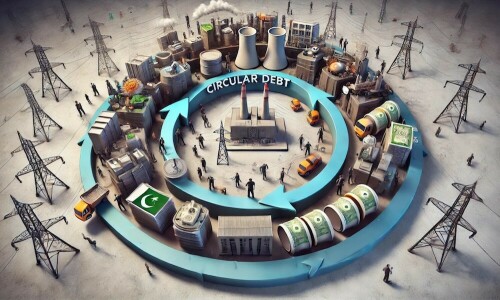
Amid little reform and a stock of over Rs4.6tr circular debt, Pakistan’s energy sector continues to weigh heavily on its economy across all sectors, owing to weak collections, theft, poor infrastructure, governance problems, and market inefficiencies.
“Taken together, there is about 4pc of GDP worth of debt stemming from the energy sector. The repercussion of this debt reverberates throughout the economy, not only impacting the fiscal but also growth, inflation, the external balance, and the financial sector”, observed Washington-based Institute of International Finance (IIF).
It said circular debt and energy subsidies added significant pressure to public finances, contributing to persistent fiscal imbalances and forcing the government to allocate resources away from other investments, social programmes, and infrastructure projects, and crowding out the private sector.
Published in Dawn, September 25th, 2025