Iran’s president hails Pak-Saudi defence deal as beginning of ‘regional security system’


 0
0
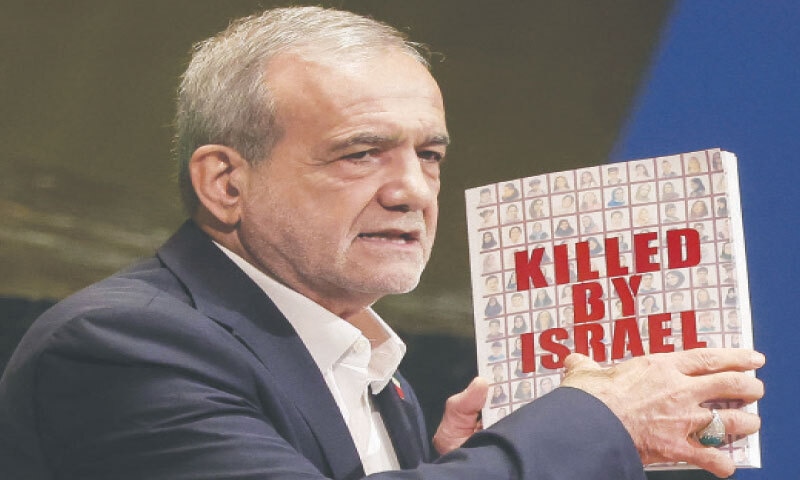

KARACHI: Iranian President Masoud Pezeshkian on Wednesday welcomed the defence pact between Pakistan and Saudi Arabia as the beginning of a “comprehensive regional security system”.
Under the agreement signed by Islamabad and Riyadh last week, an aggression against one state will be considered an attack on both. The pact was signed by Prime Minister Shehbaz Sharif and Saudi Crown Prince Mohammad bin Salman at the Al Yamamah Palace in Riyadh.
The Iranian president praised the defence deal while in his address to the United Nations General Assembly (UNGA).
“Iran welcomes the defence pact between the two brotherly Muslim countries, Saudi Arabia and Pakistan, as a beginning of a comprehensive regional security system with the cooperation of the Muslim states of West Asia in the political, security and defence domains,” he said.
Macron tells Pezeshkian only hours remain to avert nuclear sanctions
Foreign Minister Ishaq Dar had hinted last week that some countries were showing interest in entering into defence agreements with Pakistan following the deal.
“It’s premature to say anything, but some other countries want to enter into an agreement of this nature,” Ishaq Dar had told reporters in London.
No nuclear weapons
Iran’s president repeated that his country is not seeking nuclear weapons, after military strikes by Israel and the United States earlier this year, and impending sanctions triggered by European powers. (Agencies add) “I hereby declare once more before this assembly that Iran has never sought and will never seek to build a nuclear bomb,” President Masoud Pezeshkian said.
“The one disturbing peace and stability in the region is Israel, but Iran is the one that gets punished,” he said.
Iran has long contended that it is not seeking nuclear weapons, pointing to an edict by Supreme Leader Ayatollah Ali Khamenei, and US intelligence has not concluded that the country has decided to build a nuclear weapon. But Israel, the United States and European countries have long been skeptical due to the country’s advanced nuclear work, believing it could quickly pursue a bomb if it so decided.
Britain, France and Germany have moved to reimpose UN sanctions that had been suspended under a 2015 nuclear deal that was negotiated by the United States and then torn up by US President Donald Trump.
Macron warning
French President Emmanuel Macron warned Iran’s president there were only “hours left” for a deal on Tehran’s nuclear programme to avert deep sanctions, even after Masoud Pezeshkian insisted his country does not seek an atomic bomb.
France, along with Britain and Germany, had set the clock ticking at the Security Council for the reimposition of wide-ranging UN sanctions that, without a deal, will kick in at the end of Saturday.
Iranian Foreign Minister Abbas Araghchi met on Tuesday with his European counterparts, leading to no clear headway other than an agreement to keep talking.
Pezeshkian accused the Europeans of bad faith, saying that Iran’s lack of cooperation was in response to Trump’s withdrawal from the nuclear deal, formally known as the Joint Comprehensive Plan of Action (JCPOA).
“They falsely presented themselves as parties of good standing to the agreement, and they disparaged Iran’s sincere efforts as insufficient,” Pezeshkian said. “All of this was in pursuit of nothing less than the destruction of the very JCPOA which they themselves had once held as a foremost achievement.”
“An agreement remains possible. Only a few hours are left. It’s up to Iran to respond to the legitimate issues we have raised,” Macron wrote on X after meeting Pezeshkian at the United Nations.
Iran has long contended that it is not seeking nuclear weapons.
Published in Dawn, September 25th, 2025