Syrian President Ahmed al-Sharaa has departed for the United States, state media reported on Sunday, on a landmark trip that will see him address the United Nations General Assembly.
State television said Sharaa was en route “to the United States of America to participate in the affairs of the 80th session of the United Nations General Assembly in New York”, citing a presidency statement.
Sharaa seized power in December after his rebel group led a lightning offensive that toppled longtime ruler Bashar al-Assad after nearly 14 years of civil war and more than half a century of brutal family rule. He is set to speak at the UN General Assembly in New York, the first Syrian leader to do so since Nureddin al-Atassi in 1967.
Sharaa has undergone a dramatic transformation since taking power, meeting foreign leaders such as US President Donald Trump in Riyadh and French President Emmanuel Macron in Paris on his first trip to the West.
In a pre-recorded interview broadcast on Sunday, Sharaa told US broadcaster CBS that “President Trump took a big step towards Syria by lifting the sanctions with a quick, courageous and historic decision”.
“He recognised that Syria should be safe, stable and unified.” Trump lifted most US sanctions on Syria, which date back to the Syrian war and earlier, in the spring.
Sharaa added that anyone seeking to maintain sanctions on Syria would be “would be complicit in killing the Syrian people once again”.
He moreover criticised the international community for failing to halt the brutalities committed by Assad’s government.
He said, “We should be the ones asking others: why did you stand silent as these terrible crimes were taking place in Syria?”
Syria-Israel talks
The Syrian leader remains under UN sanctions and a travel ban due to his past and must request exemptions for all foreign trips. His foreign minister, Asaad al-Shaibani, is already in Washington for an official visit.
Shaibani’s office said he held a series of meetings since his arrival, including with US senators and state department officials.
He also met with the US Commission on International Religious Freedom, as the international community presses Syria’s new authorities to protect minorities in the multi-confessional country, which has seen sectarian bloodshed in recent months.
A foreign ministry official had said Shaibani aimed to discuss ongoing negotiations with Israel and the lifting of the remaining US sanctions on Syria.
Syria and Israel remain technically at war, but opened direct negotiations after Assad’s overthrow, and Syrian and Israeli officials have met on several occasions.
The foreign ministry official had said Syria expected to finalise security and military agreements with Israel this year, in what would be a breakthrough. Israel has demanded a demilitarised zone in southern Syria.
Last week, Sharaa said Syria was negotiating with Israel to reach a security agreement that would see Israel leave the areas it had occupied in recent months.
Syria to select new parliament on October 5
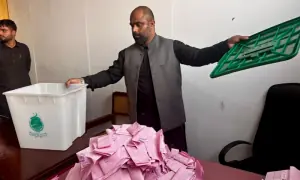
Meanwhile, Syria is set to hold the selection process for a transitional parliament on October 5, in accordance with a constitutional declaration announced earlier this year, the electoral commission said today.
The People’s Assembly of Syria was dissolved by Sharaa and the upcoming legislature, which will serve for a five-year transitional period, will comprise 210 lawmakers.
Of these, 140 will be designated by local committees supervised by the electoral commission and 70 will be directly nominated by interim President Ahmed al-Sharaa.
The process will be held on October 5, “in the electoral districts of Syria’s provinces”, the commission wrote on its Telegram channel. It did not specify if all provinces would take part.
In late August, the government announced that the selection would be delayed in the Druze-majority province of Sweida — the site of deadly clashes in July — and in the Kurdish-held regions of Raqa and Hasakeh, due to the security and political situation.
The system for appointing the interim parliament has been a target of major criticism by the opposition and civil society groups, which have denounced the concentration of powers in the president’s hands and insufficient representation of the country’s ethnic and religious minorities.
According to the constitutional declaration adopted in March, the transitional parliament will have a renewable mandate of 30 months. It will exercise its role until a permanent constitution is adopted and new elections are held.