ISLAMABAD: Pakistan and Iran have signed a series of crucial protocols aimed at dismantling tariff and non-tariff barriers, expanding electricity exchanges, and strengthening communication channels to increase bilateral trade volume significantly.
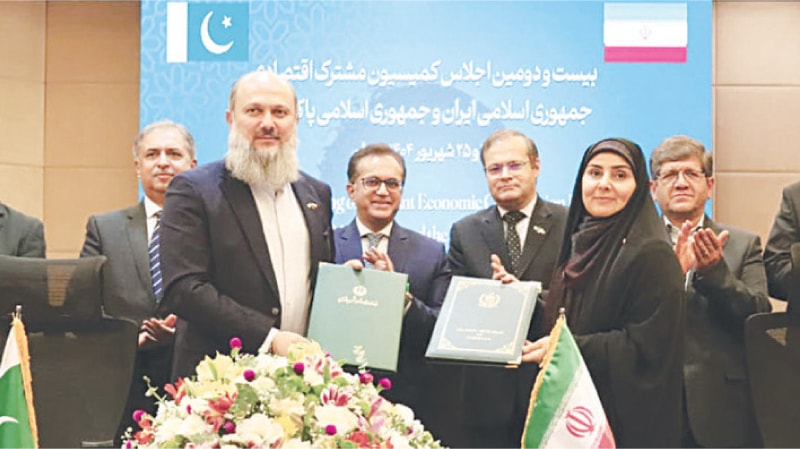
The protocols were signed at the conclusion of the Pakistan-Iran Joint Economic Commission (JEC) held in Tehran. Pakistan’s Commerce Minister Jam Kamal Khan and Iran’s Minister for Roads and Urban Development Farzaneh Sadeq led their respective delegations during the signing ceremony.
An official announcement of the commerce ministry released on Wednesday said that the signing of the protocols will help achieve a $10 billion trade target between the two countries.
In a separate engagement, Mr Jam Kamal held talks with Iran’s First Vice President Mohammad-Reza Aref to advance bilateral trade cooperation. The meeting centred on removing trade barriers, exploring export-import opportunities, and strengthening regulatory alignment between the two countries.
Agreements cover trade, energy, transport and labour mobility
Under the newly signed protocols, Pakistan and Iran reaffirmed their commitment to deepening trade and investment ties by eliminating tariff and non-tariff barriers, activating cross-border markets, and encouraging regular Business-to-Business (B2B) engagements to strengthen commercial linkages.
In the energy and infrastructure sectors, both sides reached consensus on expanding electricity exchanges, including the revival of construction on a 220-kilovolt transmission line to Gwadar.
Discussions also included joint exploration of renewable energy initiatives. A dedicated Joint Working Group will facilitate investment in the power sector, while enhanced cooperation in water resource management and sustainable urban development was identified as a strategic priority.
In the domains of agriculture and environmental sustainability, both countries pledged to implement agreements on veterinary health standards, pest control measures, and joint development of agricultural seeds and equipment. Collaborative efforts will also target climate-related challenges, including mitigation of sand and dust storms and the conservation of mangrove ecosystems.
Transportation and connectivity emerged as strategic priorities, with accords to reinforce road, rail, air, and maritime links. Key initiatives include boosting rail cargo capacity, upgrading air navigation systems, and exploring passenger ferry services — particularly for Zaireen — between designated seaports.
Cultural and educational exchanges received renewed momentum through planned cultural festivals, joint media productions, academic collaborations, student mobility programs, and vocational training initiatives aimed at deepening people-to-people ties.
Agreements on joint training programmes, harmonisation of pharmaceutical registration protocols, and coordinated cross-border disease surveillance mechanisms marked progress in health sector collaboration.
Labour mobility received a boost through the establishment of a Joint Committee on Labour Cooperation, tasked with facilitating workforce movement in key sectors including construction, textiles, and agriculture. Both countries also reiterated their commitment to counter-narcotics efforts, agreeing to intensify intelligence-led operations and strengthen border coordination. Proposals to streamline visa procedures for businesspersons and commercial drivers were tabled, aimed at easing cross-border movement and enhancing trade facilitation.
Published in Dawn, September 18th, 2025