FAO leading countrywide flood impact assessment on govt’s request

ISLAMABAD: The Food and Agriculture Organisation (FAO) is leading a comprehensive national geospatial flood impact assessment which will deliver precise, quantitative estimates of flood impact using high-resolution satellite imagery combined with Pakistan-specific remote-sensing based crop mask datasets, ensuring greater accuracy.
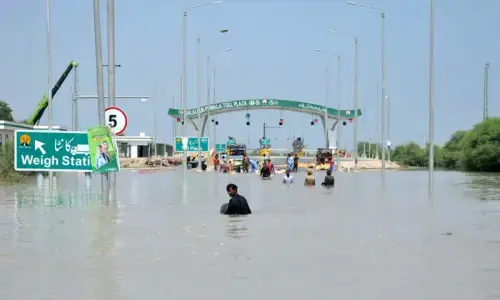
Following the monsoon floods across Pakistan, the ministry of national food security and research requested the FAO to lead a comprehensive national geospatial flood impact assessment. The floods have resulted in severe human and economic losses, with widespread casualties, mass displacement, and extensive damage to agriculture.
According to UN Office for the Coordination of Humanitarian Affairs (UNOCHA), the assessment will provide a district-wise cropland and crop type damage to support planning for disaster response and recovery.
The first assessment is expected to be available next week.
The UNOCHA says a Rapid Needs Assessment (RNA) has been initiated in Punjab and data collection is almost complete in eight districts — Sialkot, Muzaffargarh, Kasur, Multan, Bahawalpur, Chiniot, Narowal and Jhang. Five additional districts — Okara, Bahawalnagar, Hafizabad and Gujrat assessments have also started.
The UNOCHA says an additional $500,000 from the Asia and Pacific Humanitarian Fund (APHF) has been planned to be allocated to humanitarian partners working in Punjab.
Last week, the UN Central Emergency Response Fund (CERF) allocated $5 million for the provision of safe drinking water, food, shelter, hygiene kits, mosquito nets and cash assistance for access to health services, and psychological support. CERF funds supplemented the $250,000 allocated by AFPH for local NGOs to deliver essential lifesaving interventions in Khyber-Pakhunkhwa.
According to the UNOCHA, with many UN agencies and NGOs having nearly exhausted their funds, there is an urgent need for funds to the Pakistan Humanitarian Fund to meet the most critical humanitarian needs of the affected population.
Published in Dawn, September 16th, 2025