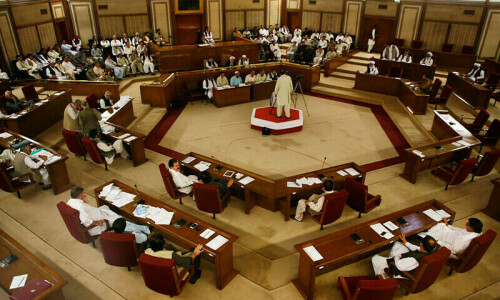
QUETTA: Amid criticism by the opposition, the Balochistan Assembly passed more amendments to the Anti-Terrorism Act 1997 focused on the protection of judges and prosecution in a bid to “provide a flexible and secure legal framework for the state to respond to evolving security challenges”.
The Anti-Terrorism Balochistan (Amendment) Bill 2025 was tabled by Parliamentary Secretary Mir Zareen Khan Magsi on behalf of the provincial home department, whose minister in-charge is Chief Minister Sarfraz Bugti.
The bill said it aimed to strengthen the counter-terrorism framework in accordance with international standards. “In light of the evolving security challenges and the sensitive nature of terrorism related cases, the bill seeks to empower the government to implement additional protective measures for the safety and security of judges, public prosecutors, defence counsels, witnesses, and other individuals involved in such proceedings,” it said.
The bill introduces a procedure for handling “sensitive terrorism-related cases through a confidentially appointed BS-21 officer”. This officer, who will remain anonymous, would determine whether a case required extraordinary protection under this new iteration of the anti-terrorism measures.
“If so, the chief justice concerned constitutes a panel of five judges and forwards it to the designated authority, who then assigns the case to judge selected from that panel”.
A similar procedure will be adopted for prosecutors from a panel of five in consultation with the prosecutor general concerned. The new amendment also “enables the use of anonymity protocols” as well as virtual proceedings, besides advanced security technologies to safeguard all participants in the trial process.
Similarly, the identities of all those involved in the trial will remain hidden for security purposes and if a courtroom “is used for physical hearings, it shall be situated in secure premises, accessible only to judges, counsels, public prosecutors, witnesses, defence counsels and persons concerned with the trial”.
Under this bill, the “designated authority” shall be nominated by the provincial government and its identity “shall be kept confidential and shall only be communicated to the chief justice”.
The authority will consult with the chief justice for performing functions, such as deciding whether a case or a class of cases requires extraordinary protection measures, assigning cases to the judges; and consulting and coordinating with the Balochistan government.
“These measures aim to preserve judicial independence, uphold due process, and ensure the effective prosecution of terrorism related offences,” the bill read.
Opposition concerned
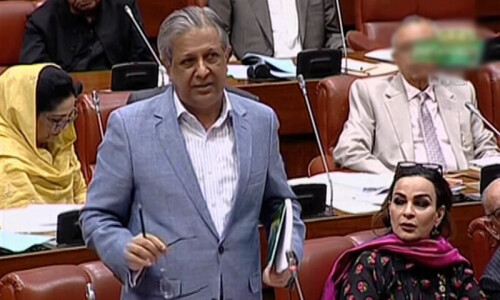
JI leader Maulana Hidayatur Rehman warned that the proposed law would undermine justice and human rights. “We will now serve justice through WhatsApp,” he quipped. According to the JI leader, if any innocent person were killed under the new law, the current government would be responsible. He said that instead of bringing this law, reforms should be introduced in the judiciary. “This law is a murder of human rights and justice,” he claimed.
However, Chief Minister Mir Sarfraz Bugti defended the bill. He said the counter-terrorism law would not be used against political workers, but solely to punish terrorists in accordance with the law. CM Bugti emphasised that the bill did not deny fair trial rights, and defence lawyers would have access to witnesses before judges.
On the issue of missing persons, the chief minister pledged that the government would permanently resolve the matter through legislation. “Any person arrested will be immediately reported to their family and the magistrate,” he assured. CM Bugti also announced strict action against poppy cultivation, revealing that 35,000 acres of poppy had already been destroyed this year. He vowed to confiscate lands given to Afghan cultivators and end illegal trawling in Makran, calling it “another form of terrorism”.
Levies-police merger
The provincial assembly also passed the Balochistan Forensic Science (Amendment) Bill 2025 and the Balochistan Levies Force Bill 2025 under which the Levies would be merged into the Balochistan police.The Maulana argued that the bill required further consultations. Provincial Irrigation Minister Mir Sadiq Umrani, however, noted that the government had invited the opposition for dialogue but could not force their participation.
Published in Dawn, September 11th, 2025