0
0

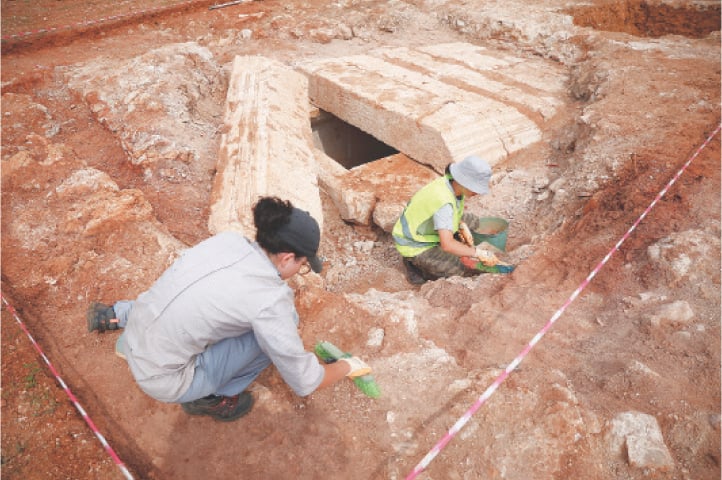
STRIKCAN: Archaeologists in Albania have discovered a large Roman burial chamber dating from the third to fourth century AD, the first of its kind found in the Balkan country that was once part of the Roman Empire.
Tipped off by locals who had noticed some unusual stones on a plateau near the North Macedonia border, staff from the Institute of Archaeology began excavating in early August and found the underground structure whose large limestone slabs were inscribed with Greek lettering.
“The inscription tells us that the person buried here was named Gelliano, a name typical of the Roman period. We are uncertain about the identity of the second individual, but it is likely a family member,” said Erikson Nikolli, the project’s lead archaeologist.
The tomb, which measures nine metres by six metres (29 ft by 19 ft), is the first discovery in Albania of what the experts believe to be a wealthy person’s resting place, grander than other burial sites found in the area.
Local authorities in Albania, where tourism is booming, are already planning to develop the site into a tourist attraction, while residents flocked to the area upon hearing the news of the discovery. Last week, Nikolli’s team used brushes to reveal the intricately carved edges of the tomb’s white roof stone and walls.
“We also uncovered a piece of fabric embroidered with gold thread, which confirms our belief that we are dealing with a member of the upper class.” Other findings include glass plates and knives.
Nikolli said that the tomb had been looted at least twice once in antiquity and later when heavy machinery was used to move a massive rock on top of the chamber.
He explained that the occupants name was inscribed in Greek letters but carried a Latin meaning, while a second inscription indicates that the tomb was dedicated to the god Jupiter.
Experts have yet to decipher additional inscriptions on stones found nearby, which are believed to have belonged to another monument now surrounded by cornfields and a quarry.
Published in Dawn, September 9th, 2025