PESHAWAR: A reassessment of last month’s flood damage and rehabilitation needs in the Malakand Division has reduced the estimated costs from Rs12.2 billion to Rs5.79 billion.
Officials told Dawn that the local government department carried out the “re-verification” of damage, which was reported by authorities at the village and neighbourhood council level, the only grassroots government in the province.
A senior official said a “three-tier mechanism” was used to check the damage assessment reports received from the district administration.
The documents show that after the Aug 15 rains, which caused over 400 causalities and widespread infrastructure damage across Malakand Division, the provincial government tasked local government secretary Saqib Raza Aslam with “coordinating collection of the data of the damage assessed by the communication and works, public health engineering, local government and irrigation departments, and prepare rehabilitation plans.
They noted that the damage assessment exercise began from the offices of the Water and Sanitation Services Company Swat following a visit to the flood-affected areas and it was decided to limit the assessment to damage incurred after the early hours of Aug 15 and it would be geo-tagged.
The documents also revealed that it was decided that the restoration would mean rehabilitating infrastructure to what it was on Aug 14, while the complete rehabilitation would be reported and calculated separately. Also, the LG teams will assess damages and calculate rehabilitation independently as a third party verification.
The damage assessment reports submitted by the relevant departments were scrutinised thrice between August 19 and 25.
The assessment carried by the line departments put the cost of rehabilitation of 538 damaged development schemes at over Rs12.2 billion with the communication and works department claiming the major chunk of losses worth over Rs7 billion. The irrigation department came up with the figure of Rs4.7 billion and the public health engineering department with Rs442 million.
The documents noted that LG department through its field formations “re-verified” the estimated costs of rehabilitation.
They showed that teams were constituted comprising the secretary of the village and neighborhood council, sub-engineer, patwari halqa, assistant engineer, assistant director and senior official of district administration. Also, elected representatives and secretaries of every village and neighbourhood council also independently reported whether or not their area was affected.
The documents revealed that the teams later visited every affected project site and took feedback from the community as well, while the damage was assessed on a predefined proforma.Teams of the director general (monitoring and evaluation) at the planning and development department were asked to help “cross-verify” LG teams’ working.
The documents said that the re-verification showed that the schemes damaged before Aug 15 were also included for rehabilitation. In addition, on several occasions, geo-tags were found missing and the schemes slated as damaged were duplicated.
The LG department’s exercise showed that out of 1,053 village and neighbourhood councils in eight districts of Malakand division, just 273 were affected by the Aug 15 rains and floods.
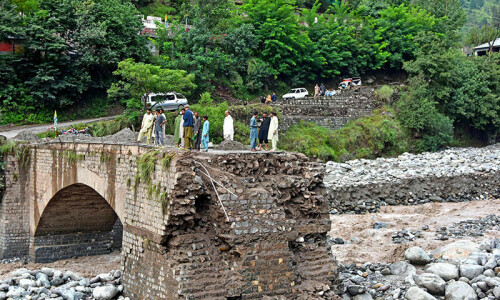
The final damage assessment report revealed that a total of 923 development schemes were damaged in 273 village and neighbourhood councils of the Malakand Division, including 238 roads, 109 bridges, 87 drinking water supply schemes, 91 irrigation channels, 212 retaining walls, 154 sanitation schemes and 32 public buildings. The exercise put the cost of the rehabilitation of the damaged facilities at Rs5.7 billion compared instead of the initial Rs12.2 billion, according to documents.
Published in Dawn, September 4th, 2025