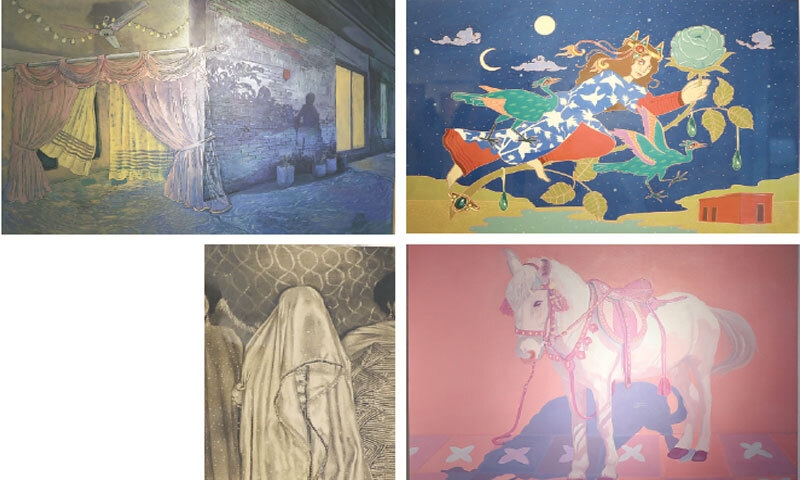

ISLAMABAD: A group show featuring six contemporary artists presents a compelling exploration of the female gaze turned inward, memory, personal archives and the multifaceted experiences of womanhood in South Asia.
The exhibition titled ‘In the Name of Love’, which opened at Dastaangoi Gallery on Saturday, showcases brilliant works by the artists transforming their personal experiences into a shared archive of memories and constellations of meaning.
Each artist, in their distinct voices, has depicted the fluidity of memory, the weight of personal and cultural archives, and the construction of identity within domestic and societal spaces.
Sana Haider, the manager of the gallery, said it’s a wonderful show and being part of it from selection to display of artworks is a very enriching experience.
Quratulain Dar’s work stands out for its sharp critique of social issues, dissecting gender and power dynamics. Pieces like “I Bite” and “Trophy” embody defiance, challenging viewers to consider the external forces that shape internal worlds.
Award-winning artist and faculty member at Kinnaird College for Women, Dar told Dawn that her work “intertwines personal experiences with broader social issues, particularly patriarchy,” dissolving the line between the personal and the social.
“I Bite” acts as a powerful allegory for reclaiming agency and rejecting the passive, silent femininity expected by South Asian patriarchal society.
“Drawing deeply from the cultural landscapes, social behaviours, and characters that shaped my upbringing, my work serves as both a reflection and testament to the world I’ve encountered, filtered through a personal lens,” she commented.
Aimen Katia blends elements of magic realism and surrealism, delving into themes of loss of innocence and memory traces. Her oil paintings, like “The Witness Forgets”, and “Trace of a Dream”, with their “tormented innocence” and “elusive” shadows, set a tone of haunting ambiguity, loss of innocence and recollecting fading memories.
“Aimen’s work explores the fleeting nature of memory — how it fades, distorts, and resists certainty,” stated Robella Ahmed, the curator.
“Shadows and forms often behave independently from their sources, becoming metaphors for memory itself, elusive, overlapping, and unreliable,” the artist said.
Khadijah Rehman, another visual artist from Lahore, works in both traditional and digital mediums.
Her gouache works blend the visual language of South Asian miniatures with old family photographs to create compositions that are reminiscent of dreamscapes.
In her two paintings, “Sleepless at 2AM” and “The Great Escape”, she creates a woman-centric, surreal world exploring the inward experiences of South Asian women.
Drawing from Mughal miniature with skewed compositions and natural elements of love, longing, and transformation, Rehman uses a nighttime backdrop for strange, introspective scenes and liminal space where women interact, reflect, and go about their daily rituals.
In contrast, Mahrukh Khizar explores interpersonal relationships between women, focusing on the mother-daughter relationships and the limitations placed between them due to patriarchal norms that shape these bonds.
The symbolism of domestic objects, including carpets, curtains, tapestries and upholstered furniture, creates a powerful vocabulary of belonging and invisibility, directly engaging with the patriarchal norms.
Noorul Huda, a Lahore-based visual artist, explores the complexities of paint, building narratives on personal recollections. A two-time recipient of the ‘Alhamra Young Artist Award’, Ms Huda reflects on social norms, time and memory.
Huda’s large-scale, mixed-media canvases, such as ‘Beyond the Veil’ and ‘Perpetual Enigma’, depict connection and disconnection, as well as dissociation, examining how social norms and power dynamics shape human behaviour and relationships.
Vania Mazhar, another Lahore-based visual artist, has explored the mundane moments of daily life, family archives, and the concept of home, using mediums such as painting, drawing, video art, and projections.
Through observation, documentation and a ton of drawing, Ms Mazhar captures the overlooked mundane intricacies of everyday life in a manner that is almost like sketching with brushstrokes.
Published in Dawn, August 25th, 2025