0
0

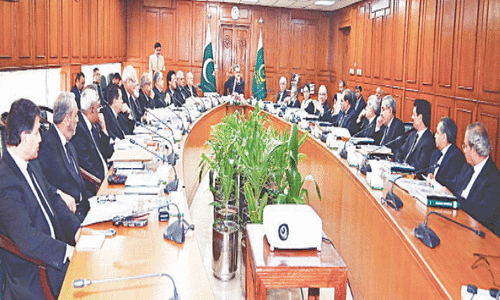
ISLAMABAD: A subcommittee of the Judicial Commission of Pakistan (JCP) on Friday opposed the proposal to develop criteria for judges’ selection for the constitutional benches, formed under the 26th Amendment, and referred its recommendations back to the JCP for a final decision, an informed source confided to Dawn.
The five-member panel, which met under the chairmanship of Justice Jamal Khan Mandokhail, with a majority of three to two referred the recommendations back to the JCP for perusal and final decision.
The subcommittee considered three agenda items: drafting criteria for judges’ selection for the constitutional benches, framing rules for performance evaluation of judges of all high courts, and considering rules for the service structure of JCP secretariat.
The service rules were approved by the subcommittee.
Justice Mandokhail-led subcommittee approves rules for service structure of JCP secretariat, defers framing of rules for performance evaluation of judges of all high courts
Attorney General for Pakistan (AGP) Mansoor Usman Awan, Senator Farooq H. Naek from the treasury, and representative of the Pakistan Bar Council (PBC) Mohammad Ahsan Bhoon opposed the proposal to develop criteria, whereas Senator Barrister Syed Ali Zafar, on behalf of the opposition, highlighted the need for outlining such rules. Justice Mandokhail abstained, the source claimed.
On June 19, Chief Justice of Pakistan (CJP) Yahya Afridi constituted the broad-based committee for judicial performance evaluation of high court judges.
It comprised members from the judiciary, parliament, executive, and the legal fraternity, tasked with preparing draft rules for annual judicial performance evaluations as well as developing criteria for judges’ selection for the constitutional bench.
During the meeting, it was considered that Article 191A does not empower drafting rules for judges’ nomination for the constitutional benches, since all Supreme Court judges had been elevated from different high courts where they had exercised constitutional jurisdiction while hearing legal matters.
Filters may bar judges from full court
It was argued that if any filters were developed through such criteria, it would mean that judges who did not meet the standard would be excluded from sitting on the full court. This would particularly affect demands to enlarge the constitutional bench into a full court by including all available SC judges. In such a case, the constitutional bench could never become the full court, since some judges might not fulfil the yardstick, the source said. He added that if such judges could not sit on the full court, then questions would arise as to why they were included earlier when the full court decided constitutional matters such as the SC (Practice and Procedure) Act, 2023.
Meanwhile, the subcommittee deferred the agenda of framing rules for regulating performance evaluation of all high court judges, though it acknowledged that Article 175A (4) empowers the committee to develop fitness evaluation rules. The matter will be revisited in near future.
In June, the JCP in a majority decision extended the tenure of the SC constitutional bench till Nov 30, 2025.
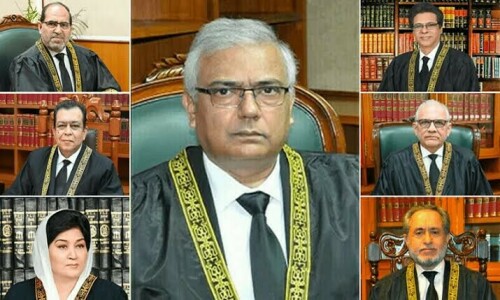
Under the 26th Amendment, a seven-judge constitutional bench was initially formed on Nov 5, 2024 for a period of 60 days. The bench included Justices Aminuddin Khan, Jamal Khan Mandokhail, Mohammad Ali Mazhar, Ayesha A. Malik, Hassan Azhar Rizvi, Musarrat Hilali, Naeem Akhtar Afghan, and Shahid Bilal Hassan.
In December, its tenure was extended for six months. In February, the constitutional bench was expanded to 13 members with the inclusion of Justices Hashim Khan Kakar, Salahuddin Panhwar, Shakeel Ahmad, Aamer Farooq, and Ishtiaq Ibrahim.
Published in Dawn, August 23rd, 2025