



 0
0

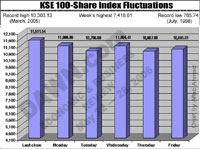
 DESPITE strong weekend rally, the stocks suffered fresh erosions last week as tax-related worries followed by conflicting rumours kept the investors on toes all along as their weaker links were out after selling the holdings at loss. The KSE 100-share index was off by another 650 points at 10,861.31, eroding Rs179 billion from the market capital.
In spite of massive pruning of the majority overvalued shares, including blue chips, leading bulls and institutional players tried to restore the investor-confidence after injecting big amounts to avert a major crash. However, the situation remained terribly grim.
But some analysts predicted that the worst was over as bears seemed to have exhausted all negative rumours. The tax on shares was denied by the CBR as more than twice it took the steam away from the market in the week.
Pakistani stocks last week fell like the house of cards on panic-selling triggered by the rumours of new taxes in the federal budget due next month, despite official denials. However, the market remained in the grip of leading bears. The early rumours about tax on capital gains were later denied by the CBR which had caused the weekend rally.
The KSE 100-share index crashed from recent highs by plunging down seven per cent or 650.23 points at 10861.31, eroding Rs179 billion from the market capital at Rs3,060 billion. This, however, was caused due to the combination of negative rumours about the future economic perceptions and worries about tax proposals in the national budget.
The extension in reported uncapping or increase in funding under the CFS to July 31 from June 30 also worked against sentiments as investors sold in haste their long positions fearing the market collapse any time.
Bears ruthlessly exploited rumours in each session leaving a long list of casualties but the financial institutions did not resort to rescue operation and watched the market slaughter from the outside, some analysts lamented.
The heating up of political scenario after signing the Charter of Democracy by two major political parities in London last week according to analysts, was a significant development but the contenders of power could interpret it according to their own perceptions - sans investors.
Click to view the larger image
The massive fall of 414.68 points at 11,096.86 which eroded Rs113 billion from the market capital at Rs3,126.00 billion reflected that the worst was still to come in an overbought market, analysts said.
Just from the opening bell, the market witnessed a beeline of sellers but no matching buying offers at falling prices and the crash intensified with each passing minute amid panic that followed.
All roads may not be leading to the Khalian Road, Wall Street of the KSE, the panicked sellers tried to get out of the market leaving behind a long list of casualties, notably of small investors and savers, said a leading broker while commenting on market crash.
It was, however, not the largest single session fall - the highest so far being 491.02 points or 4.43 per cent recorded on March 8, on rumours of tax on shares and 468.20 or 4.10 per cent on March 6, 2006, due to a negative fallout of President Bush’s visit followed by panic-selling.
Although the budget was three weeks away, rumours of an increase in withholding and value-added taxes in the new federal budget worried leading punters and small investors who liquidated their positions fearing further fall in the prices.
There was confusion all-around after the opening as everyone was a seller but no one was inclined to buy at the falling prices. All leading bank, oil and cement shares fell from their recent highs like the house of cards closing with lower locks.
Future economic perceptions may not be that bleak amid a growth rate of above six per cent but some leading bears made it look so, analysts said adding that the absence of buying at dips further aggravated the situation.
No one could deny the fact that the market was still in an overbought position and needed correction and a section of brokers have exploited the situation amid reports that it was the end of interim dividend news for the first quarter.
But what seemed to have triggered panic-selling by some leading institutional traders were reports that the rates on deposits were expected to be increased to bring down the bank spread to a normal level, analysts said.
Some leading shares whose floating stock was not easily available were led by the Pakistan Hotels and the Nestle Pakistan rose and were followed by the Haroon Oils, the Pakistan Resource Company, the Bolan Castings, the Pakistan Engineering and the Pakistan Electron.
The Unilever Pakistan and Arif Habib Securities fell by Rs25 and 30.05 respectively. Other leading losers included the MCB, Bhanero Textiles, Millat Tractors, the PSO, Attock Petroleum, Pakistan Petroleum, Colgate Pakistan, Pakistan Oilfields and Shell Pakistan posted sharp fall.
FORWARD COUNTER: Active speculative shares also followed the lead of their counterparts on ready counters and fell sharply lower under the lead of the National Bank, the OGDC, Pakistan Petroleum, the MCB, the D.G. Khan Cement and some others and may take quite some time to recoup the losses suffered last week.—Mohammad Aslam






























