



 0
0

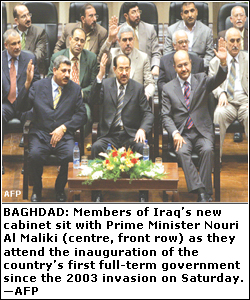 BAGHDAD, May 20: Prime Minister Nuri al Maliki was thrust to the forefront of Iraqi politics a month ago with the image of a tough, Shia Islamist strong enough to weld warring factions together into a national unity government.
That he forged a cabinet a couple of days before a deadline, has won him praise in some quarters, notably from US officials anxious for a leader who can stem a drift towards civil war.
His performance on Saturday, marshalling his team’s approval through parliament with little ceremony and giving a brisk, no-frills rundown of a 34-point policy programme, was in keeping with the no-nonsense style that has won him admirers.
Taking personal charge of improving security and public services and of cracking down on corruption, he made a priority of national reconciliation, saying he aimed to ‘close up the divisions that have emerged through sectarianism’.
A delay in naming interior and defence ministers was seen by some officials as a mark of his commitment to consensus rather than a sign of weakness in driving through his own agenda.
But while some minority Sunnis and others hail his switch from sectarian strongman to consensus builder, officials close to the negotiations say he has yet to prove he is able to lead his team without buckling to pressure from faction chiefs.
“He’s tried to please everyone. That’s positive in that it shows he’s above sectarian bias,” one senior negotiator said.
“But there’s also no real cohesion about the government.”
His nomination by the dominant United Iraqi Alliance bloc ended months of deadlock over his close ally and predecessor, Ibrahim al Jaafari, who had refused to step aside.
STRONGMAN IMAGE: The cerebral Jaafari, popular among Shias but distrusted by Sunnis and Americans over his ties to Iran, was known for rambling digressions during his year as prime minister. Mr Maliki is presented by Western diplomats as concise and decisive.
“He’s a listener,” said one senior Western official in Baghdad. “But you also get the impression that once he tells you something is going to happen, he’ll go away and follow through.”
Though a tough-talking defender of Shia interests in backroom negotiations since returning from exile in Syria after the invasion of 2003, he has made clear he wants to reach out to Sunni militants and tame Shia militias.
Demonstrating his will to bury past differences, one of his first acts in office was to change his own name — dropping the forename Jawad he used as cover when fighting Saddam Hussein.
Born at Hindiya, south of Baghdad, in 1950, he has a masters in Arabic and worked at the education ministry before fleeing under sentence of death in 1980 for his political activism.—Reuters



























