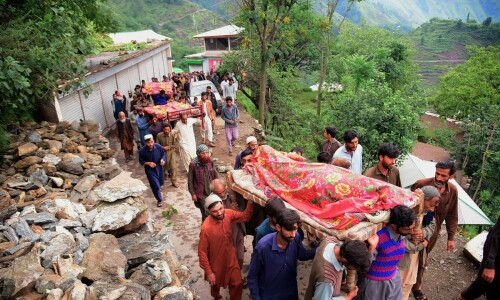
ISLAMABAD: Federal Minister for Health Mustafa Kamal on Tuesday said that the health ministry has been working in close coordination with the National Disaster Management Authority (NDMA) and the provincial governments to ensure uninterrupted medical assistance to flood-affected regions across the country.
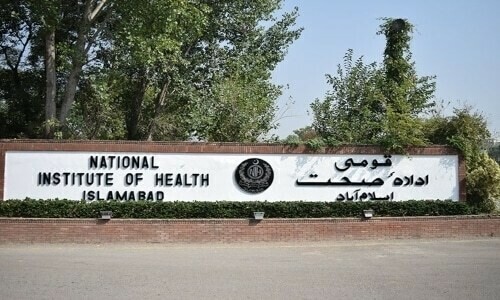
Moreover, a Command and Control Room had been established at the National Institute of Health (NIH) to monitor the evolving situation 24/7.
Addressing a press conference, the minister said that the health ministry had initiated relief operations without waiting for formal requests, and all medical requirements communicated by provincial governments were promptly provided.
“We provided 100 percent of the required medicines to the affected areas and ensured timely dispatch of medical supplies,” he stressed.
The minister highlighted that on receiving a request from Shangla district, an 18-member medical team — comprising 12 doctors from Pakistan Institute of Medical Sciences (Pims) and eight from Polyclinic — was immediately dispatched to provide on-ground healthcare services to displaced communities.
He said besides medicines, large quantities of mosquito nets were also sent to prevent the spread of vector-borne diseases in flood-hit areas.
“Preventive measures are as crucial as curative ones, and we are ensuring both,” he remarked.
Sharing details of the relief supplies, Mustafa Kamal said that 16,000 antibiotics, 14,000 antipyretics, and 10,000 painkillers had been dispatched to the affected districts. He said more than 250,000 pentavalent vaccines and 150,000 rubella and measles vaccines were provided, along with over 6,000 ORS and rehydration salts for patients in flood-hit areas.
For Gilgit-Baltistan, he said, an additional 1,400 antibiotics, 40,000 analgesics, and 1,000 anti-allergy medicines were sent to meet urgent medical needs.
He further said that the federal health ministry had already delivered 3,410 kilograms of medicines to Khyber Pakhtunkhwa and 350 kilograms to Gilgit-Baltistan. Vaccines to counter waterborne diseases caused by stagnant floodwaters have also been provided.
Mustafa Kamal underlined that all federal health institutions were on high alert and operating under strict monitoring mechanisms. “Our teams are working round-the-clock, and the entire system is under constant surveillance to respond to any emerging medical need,” he said.
He further informed that a Command and Control Room had been established at the NIH to monitor the evolving situation 24/7. “These measures are being undertaken under the leadership and directives of Prime Minister Shehbaz Sharif,” Mr Kamal noted.
PRCS teams
Meanwhile, Pakistan Red Crescent Society (PRCS) has also started working on the ground to provide immediate relief and assistance to communities affected by the ongoing monsoon rain spells, floods, and landslides in different regions of Pakistan.
Published in Dawn, August 20th, 2025