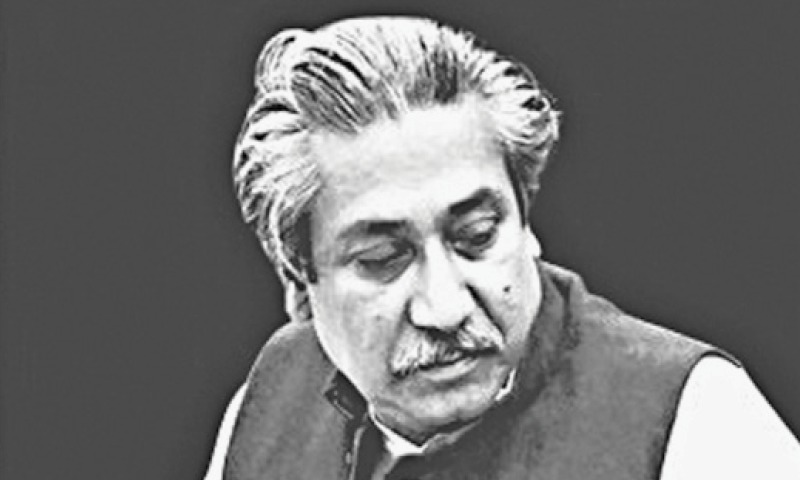

The assassination of Bangabandhu Sheikh Mujibur Rahman, along with most of his family members, on August 15, 1975 is a dark chapter in Bangladesh’s history. The cold-blooded way in which they were murdered — including his minor son, wife, and daughters-in-law, as well as individuals with no familial ties — was wshocking and reprehensible. It was also destabilising for a nation still grappling with the trauma and devastation of a nine-month bloody war.
Carried out by a group of army officers, Bangabandhu’s assassination was followed by another dastardly act on November 3 of the same year: the brutal jail killing of four national leaders Tajuddin Ahmad, Syed Nazrul Islam, M Mansur Ali, and AHM Qamaruzzaman.
Some researchers allege a foreign conspiracy behind both the assassinations of August and November, while others attribute them primarily to internal reasons and power struggles. But these were the very men who had formed a provisional government in April 1971 while Bangabandhu was imprisoned in Pakistan, trained ordinary citizens to become freedom fighters, and led the fight for ‘liberation’ against a well-equipped occupying army. Their assassinations steered the country further away from the ideals it was founded on and towards years of military rule. The governments that followed shunned democratic principles and legitimised these heinous crimes. The precedent set on August 15 made future political assassinations more conceivable, including repeated attempts on President Ziaur Rahman, one of which ultimately led to his death in a 1981 military coup, again creating a national crisis.
History must assess Sheikh Mujibur Rahman in two distinct phases: as a leader who inspired a nation to fight for its freedom, and as the prime minister after 1971, whose controversial actions, including the formation of the one-party BAKSAL system, failure to curb corruption, and perceived inability to prevent the 1974 famine, led to public disillusionment. But it is unfortunate that such a pivotal figure in our history is now often met with contempt and narrow partisan judgement, largely due to his daughter Sheikh Hasina’s obsessive deification of him and monopolising the narrative of the ‘Liberation War’.
She politicised and weaponised both the war and Bangabandhu’s legacy in order to extend her rule and clamp down on anyone she considered an opponent, whether political rivals or ordinary citizens showing signs of dissent. The student-led people’s uprising of July-August 2024 was a consequence of her 15 years of abuse of power, culminating in the killing of around 1,400 citizens. As a result, anything associated with Mujib is now anathema to many of those who suffered during her rule. But Sheikh Mujibur Rahman’s foundational role in our struggle for independence is indisputable and cannot be ignored, no matter how politicised his memory has become. Attempts to rewrite history only repeat the mistakes of past regimes.
August 15 should be remembered as a national tragedy that derailed the democratic trajectory of a newly independent nation. Commemorating it is not about political allegiance. It is not about overlooking Bangabandhu’s mistakes and failures. It is about acknowledging a truth that shaped the course of our history. Let history judge him in all his contradictions, and not through the narrow lens of politics as we often tend to do.
Published in Dawn, August 18th, 2025