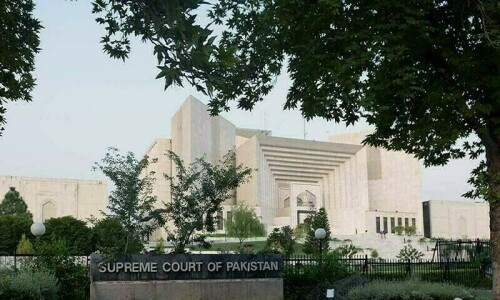
ISLAMABAD: The Supreme Court on Friday expressed deep concern over delays in adjudication across all tiers of the judiciary, warning that such tendencies erode public confidence, undermine the rule of law, and disproportionately harm the weak and vulnerable who cannot afford prolonged litigation.
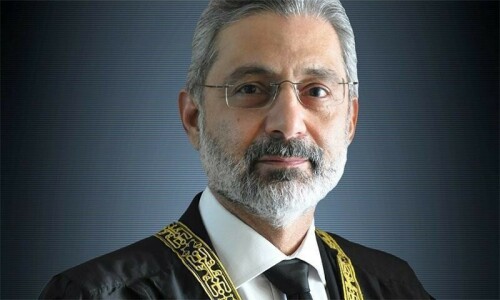
“Delay in adjudication carries severe macroeconomic and societal consequences: it deters investment, renders contracts illusory, and weakens the institutional legitimacy of the judiciary,” observed Justice Syed Mansoor Ali Shah.
Justice Shah made the observation while heading a two-judge bench, also comprising Justice Ayesha A. Malik, which was hearing an appeal filed by Abdul Salam Khan challenging the Peshawar High Court’s Nov 3, 2021 rejection of his plea.
The judge suggested introducing age-tracking protocols to automatically identify dormant cases, along with the judicious use of Artificial Intelligence (AI) tools to assist in scheduling and triage, while preserving judicial discretion.
Justice Shah warns slow adjudication carries severe economic and societal consequences
“Such a system must, at a minimum, ensure: the early fixing of cases on a non-discriminatory basis; the elimination of “queue-jumping” and preferential scheduling; and the prioritisation of matters involving constitutional, economic, or national importance without compromising the timely resolution of individual claims,” Justice Shah emphasised.
The case arose from a challenge to the auction of an immovable property by a bank in execution of a money decree dated April 26, 2010. The auction was held in 2011. The petitioner filed objections the same year, which were dismissed. An appeal before the PHC remained pending for ten years, culminating in the 2021 decision. The matter reached the Supreme Court in 2022 and was taken up now, three years later, in 2025.
The court noted that the issue was not limited to the validity of the auction but extended to whether any meaningful relief could be granted after 14 years. Even if the petitioner’s claim had merit, the sands of time have all but eroded its potency, Justice Shah remarked.
Though the Supreme Court also rejected the appeal, it observed that a justice system’s credibility rests not only on the fairness of its decisions but also on the timeliness of those decisions. The matter, it noted, was not merely administrative but constitutional, with the right to access to justice guaranteed by articles 4, 9, and 10A of the Constitution.
This right, the court said, encompassed a fair and timely trial, and delays that render a remedy ineffective amount to a denial of due process.
“Justice, to be real, must be both just and timely,” Justice Shah stressed, adding that statistics speak for themselves.
Over 2.2 million cases are currently pending before courts across the country, including about 55,941 in the Supreme Court alone, despite the increase in the number of judges to 24.
These figures are not abstract; they represent disputes suspended in time. Delay in adjudication is not merely a by-product of docket congestion or lower-level inefficiencies but a deeper, structural challenge of judicial governance, Justice Shah said. The judiciary, as a matter of institutional policy and constitutional responsibility, must urgently move toward a modern, responsive, and intelligent case management framework.
The judgement noted that judicial systems worldwide have shown that delay is not an intractable inevitability but a solvable institutional challenge. Countries such as Singapore, the United Kingdom, Brazil, Estonia, Canada, China, Denmark, and Australia have implemented reforms combining technology, structural innovation, and procedural discipline to reduce backlog and improve efficiency.
Through tools such as e-filing, real-time dashboards, automated scheduling, and transparent digital oversight, these jurisdictions have evolved from passive custodians of dockets to active managers of justice delivery, the judgement said.
These international experiences underscore a basic truth: delays in justice are not inevitable; they are the product of institutional design and can be remedied with vision, planning, and resolve, it added.
Pakistan’s judiciary must draw upon these global lessons and commit to transformative reforms integrating technological innovation, administrative restructuring, and disciplined case management, so that courts become engines of timely, transparent, and citizen-focused justice, Justice Shah observed.
Published in Dawn, August 16th, 2025