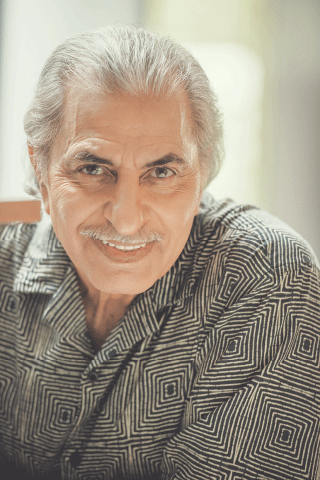
Usman Peerzada is 74, but with an energy that many would aspire to have in their late 20s. He has a busy schedule, perpetually stationed away from his home in Lahore and residing at a guest house in Karachi, rushing from one drama set to the other.
On the days that are free in between shoots, he invests his time in penning his autobiography. When there are longer gaps, he returns to his home in Lahore, enjoying a bit of cooking, a bit of gardening.
I remember discussing the possibility of an interview with him some two years ago when I had bumped into him at the airport. It has taken this long to coordinate with him but the conversation that we have is well worth the wait. In fact, it could very well serve as a sneak peek into the sizzling, honest memoirs that he is drafting.
There is, after all, so much that Usman Peerzada has observed; from his heyday as a heartthrob to taking up the producer’s and director’s chair, to working in cinema, helming a colossal festival with his family and, as the tide turned, playing a variety of different roles in multiple TV dramas. He’s seen the country endure different political regimes, ridden the liberal wave and weathered conservative policies, grappled with the consequences of terrorism and even taken the authorities head-on in order to fulfill his passions.
The veteran actor has seen it all — from his heyday as a heartthrob, to playing scriptwriter, director and producer, from film to television and helping helm the country’s largest performing arts festival. So is he content with playing the same old roles on television now?
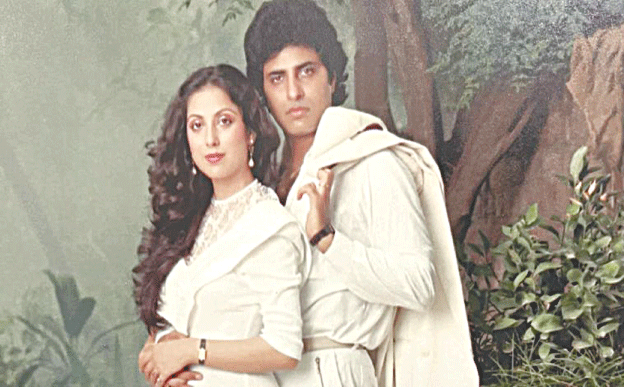
He belongs to the era when artists would set aside commercial concerns and pursue their dreams. He sold off his cars back in the late ’80s, when he was producing his movie Nazdeekiyan. He recalls, during our conversation, “My wife Samina [Peerzada] then said that winters are coming, sell three of our air-conditioners too. We did so and shot the movie in 19 days flat. It ended up being a big hit.”
He recounts another memory from his filmmaking days: “The last movie I directed was Karz, in the late ’90s, with the script written by Khalilur Rehman Qamar. It was tradition that a day before the movie’s premiere, the director would see the movie in a mainstream cinema to work with the projectionist on the sound and light, if needed. So, I sat in this cinema in Lahore and the visuals were all blurry. I couldn’t understand why — the film had looked fine in the studio but, now, the colours were dull. The projectionist couldn’t understand it either and so I jumped on to the stage and touched the screen. My finger disappeared in a thick layer of dust!”
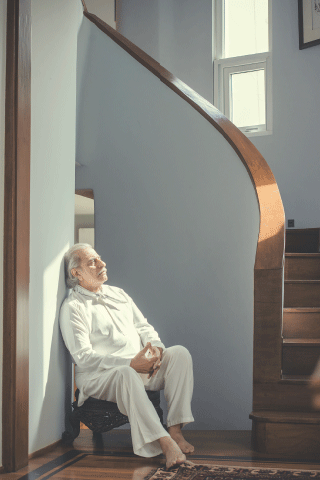
Frenzy ensued — the premiere was mere hours away — and washing powder, wipers and labour that could help out was brought to the cinema. “All through the night, we cleaned up the screen and by morning, we were throwing out buckets full of mud. My pants got torn twice, getting caught in big nails, and I saw huge rats running about. The next day, the cinema owner came and fought with me, fearing that I had ruined his premises. We had not. The movie premiered and the audience could at least see it.”
I am grateful to God that, even at this age, I am getting to do work that I know, that I enjoy,” he responds. “I earn good money, the production teams take care of me and I am always very professional. I have never made the production’s car wait for me, to take me to a shoot.”
He continues, “Anyone who went to see a movie in those days needed to be given a medal for having sat through it, despite the noise which was put forward as audio and the blurry visuals. This is how cinema eventually got killed in this country.”
And this is how a veteran actor, writer, producer and director of Usman Peerzada’s calibre, with a wealth of local and international experience, found himself treading TV’s generic waters as time progressed.
His repertoire is impressive and, yet, Pakistan’s entertainment industry has hardly benefitted from his expertise. Instead, like many of his peers, Usman — while a popular choice in TV dramas — is sequestered into playing the role of the father, the uncle or, at most, the powerful feudal lord.
Are you happy with where your career is today, I ask him.
“I am grateful to God that, even at this age, I am getting to do work that I know, that I enjoy,” he responds. “I earn good money, the production teams take care of me and I am always very professional. I have never made the production’s car wait for me, to take me to a shoot. As opposed to some of today’s actors who think that there is nothing wrong with making the driver wait for two, two-and-a-half hours.
“The shifts are long, from 10 in the morning till 10 in the night. I don’t even bother reading the contract that I am given because, ultimately, I know that I have to work according to the production house’s requirements. I am happy as long as they pay on time.” I suspect he’s pussyfooted around my question.
He then adds: “Yes, the roles I get offered are usually the same. In our country, roles don’t get written for character actors. Storylines revolve around young people.”
He continues, “Often, there are long delays and my shooting schedules for different dramas will overlap. I end up being part of six, seven dramas simultaneously, visiting the various sets according to when I am required there. It helps being part of different projects because, should payment from one get delayed, I will still be earning from my other work.”
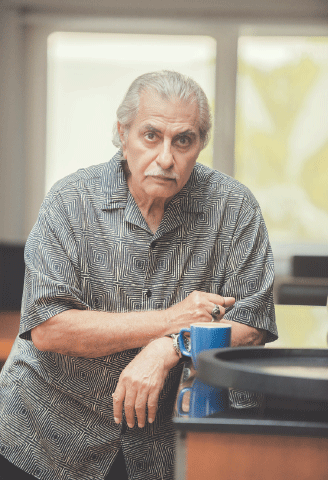
This is all very well but don’t the characters that he is playing get muddled in his head?
“Sometimes they do,” he admits. “I come on set and ask the assistant director, ‘Aaj kaunsa Aaba hoon mein?’ [What kind of father will I be playing today?]. It is literally sometimes a battle to add nuances to a character who does not have much to do. The problem lies primarily in the scripts that we get.
“For instance, I often play a feudal lord but, while the writer has a superficial idea that such a person will probably wear a shalwar kameez and have a moustache, no additional research is done on the character. When I read the script, that is when I figure out how my character will be, what his educational background will be, what kind of watch he will wear, what kind of waistcoat and shawl…”
How does he, then, convince himself to work with such scripts?
”I close my brain off. A lot of work that I do now is for financial gain rather than creative satisfaction.” Referring to his wife, actress Samina Peerzada, he says, “She does not do this, which is why she hasn’t worked in a serial for the past four, five years. There was a time when she would also be working in TV constantly, back when our daughters were studying abroad.”
Samina did, however, recently deliver a chilling performance in the horror movie, Deemak. Has he seen it? “Yes, I think Samina did extremely well in it. She is a method actor and she opted to do even the difficult scenes herself, like the one in which her body levitates. She fell ill afterwards and she is still slowly getting better.”
This makes me curious: is she feverish or just weak? How is she ill? “That I do not know but my daughter Anam, who is with her, has been quite concerned.”
This response strikes me as a bit odd. How does he not know? “I have just been here in Karachi a lot, for work.”
This vague answer prompts me to ask him: does he think that industry marriages work? He replies: “A marriage’s success depends on the people involved, not on their professions. So, whether or not a marriage between two individuals belonging to the entertainment industry works, depends on them.
“Samina and I celebrated 50 years together a few months ago. We have seen highs and lows and, for 12 years, we didn’t have children and just had each other to look at. And we’ve just floated along together, over all these years.”
I gather this is the most I will get out of him on this and, honestly, I don’t want to pry further anyway. We move on to the next question: given his experience and expertise, does he think that he could have done much more had he not continued to live in Pakistan and explored international territories more extensively?
“I don’t know,” he muses. “I have never thought of living anywhere else. I could have lived abroad. For several years, I was the Honorary Consul General of Romania in Lahore. But whenever I, or my brothers, travelled anywhere, our main motive would only be to serve our country. I don’t think there could have been any better way of doing this than by hosting a regular yearly festival, dedicated entirely to the performing arts, which would showcase the work of troupes from around the world.”
Here, our conversation segues to the famous Rafi Peer Festivals, a collective family passion project, helmed by Usman and his brothers with the rest of the clan joining in. The initial festivals were dedicated entirely to puppetry but, later, the events expanded to other genres, such as music, dance and theatre. From 1992 to 2008, a festival would take place every year, featuring not just Pakistani artists but also performances by international visitors. Sadly, terrorist activities brought the events to a halt — something that upsets Usman immensely.
“There were a few blasts and, after that, no effort was made to revive the festivals. There was no government support, no editorials in newspapers acknowledging the contributions that the festivals had made over the years and the need to keep them going,” he says despondently. “The government would have to spend billions of rupees to generate the kind of publicity that our festivals would bring to Pakistan. We invited over 14,000 people to Pakistan to participate and they would return to their homes and write articles and make documentaries about their experiences.
“The economy would also benefit. PIA sold tickets like nobody’s business and the shops in Lahore’s Liberty Market — close to the festival venue — would be thriving. The owner of the popular traditional shoe shop Khussa Mahal once asked me to tell me when the festival was coming up so that he could be prepared for his shop emptying out!”
He continues: “This one time, a Spanish group was invited to perform with us and, on the night before they flew out, their family members panicked because they thought that it would be dangerous to perform in Pakistan. The head of the group contacted an acquaintance of his who had attended one of our festivals earlier, and this acquaintance told him to dismiss all doubts and go immediately. Festivals like these were rare, where people from all over the world were performing in close proximity. It was the biggest feat of its kind in the entire Subcontinental region. The government, however, never cashed in on this. It is sad.”
The sadness in our history seems to be a recurring motif.
While the yearly festivals couldn’t survive the test of time, their contributions are an intrinsic part of the Rafi Peer legacy. There is also a lot more that is attributed to Usman and his illustrious family: his father Rafi Peerzada’s work in radio and stage, his wife and brothers’ countless contributions to the entertainment field and Usman’s own efforts — having made movies and dramas that ventured off the beaten track, having written scripts with an intuitive flair and, of course, his exceptional performances.
Numerous times, during my interview with him, I feel compelled to ask if he is happy with how his career has progressed and he repeatedly tells me that he enjoys being able to work even at his age. This may be true — he tells me he particularly enjoyed his cameo in the drama Main Manto Nahin Hoon where he plays a college dean — but it seems to me this bravado is a bit of a facade.
If only Pakistan’s entertainment industry had realised it, given his knowledge and experience, Usman Peerzada could have been doing much more. So much more.
Published in Dawn, ICON, August 17th, 2025