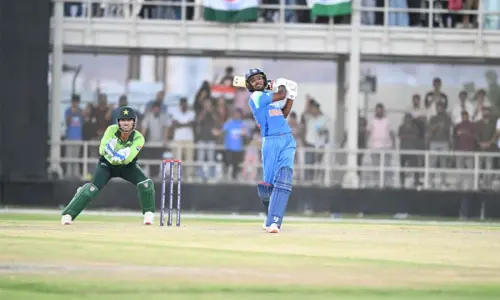
KARACHI: Ashton Turner, the Australian batter who played for the Multan Sultans during last season’s Pakistan Super League (PSL), told Dawn that the April-May heat proved to be a “struggle” for some players.
However, Turner explained, the organisers were quick to realise the issue and ensured there were several cooling breaks during the matches to make sure players weren’t affected.
Turner is one of several players advocating the need for cricket to adapt to climate change, and was featured in a recent report, Hit for Six: The Danger Zone — commissioned by non-profit groups FrontRunners, British Association for Sustainability in Sport, Climate Central and The Next Test — which highlights the increased strain on players’ bodies due to rising temperatures.
Findings from the report showed that half of the PSL matches were played in conditions meriting conditions classified as either meriting ‘Caution’ or ‘Extreme Caution’ on the Heat Index that could, at the very least, result in heat-related fatigue for the participants.
Australian batter says late starts could become new norm amid rising global temperatures
Turner featured in two matches for the Sultans — both at the start of the season when temperatures were on the lower side and without warning on the heat index — but as the PSL moved into the summer, he witnessed from the dugout the struggles of his teammates.
Data from the study shows the Sultans played five matches in conditions meriting ‘Caution’ — one each in Multan, Karachi and Rawalpindi and two in Lahore.
“It was definitely something you could feel out there,” Turner said in an interview. “We had a few games where the heat was relentless.
“As players, you try to prepare for it as best you can, but when it gets into those levels, it really affects concentration and recovery between matches.
“Some of the boys definitely struggled, even though we were hydrating constantly. It’s a real challenge, especially when you’ve got games close together.”
Turner, however, hailed the Sultans’ management as well as the PSL organisers for doing the best they could to make sure the players were comfortable.
“To be fair, the Multan Sultans management were pretty proactive with it,” he shared. “The team physios and trainers were on top of it, making sure we were cooling down properly before and after games.
“From what I understand, the PCB and PSL organisers were aware of the issue too — there were updates on conditions, and umpires provided extra breaks. But I think everyone recognised it was difficult to completely avoid the heat when scheduling is tight.”
LATE STARTS
Due to the heatwave in Multan in May, PSL had to reschedule two matches. One was shifted away from Multan to Lahore while the other was shifted to the cooler night time.
The latter game, which was scheduled to be held on May 11, did not take place due to the breakout of skirmishes between India and Pakistan that halted the PSL.
Turner believes that late starts could be the new norm for cricket due to the rising global temperatures.
“The experts say it’s likely to become much more common, and what I’ve seen even over the time I’ve played makes me agree,” he said.
“From a player’s perspective, it was definitely the right call to adjust those matches—it makes a big difference to have slightly later starts.
“The reality is, these heatwaves are becoming more regular, and you can really feel how intense it gets on the field. I think cricket boards everywhere, not just in Pakistan, will need to be more flexible with scheduling.
“Player welfare has to be a priority, and moving games to avoid the worst of the heat is a practical step. It’s not ideal, but with the way things are trending, I think we’ll see more of it.”
Turner, however, said that while professional players are well protected, it is those who are at the grassroots who are at the greater risk due to climate change.
He is calling the cricket authorities to act. And fast.
“As professionals, we’re fortunate to benefit from great resources, staff, facilities and training programmes, and mainly played games at night under lights with a few exceptions when we played in the afternoons in hot, sunny conditions,” he said.
“But kids playing cricket in the streets, at schools and local clubs don’t have the same access to these resources. Non-professional make up the majority of cricketers around the world and most of these players aren’t equipped to be playing in extreme heat. Without change, these will be the people most affected.”
Published in Dawn, July 24th, 2025