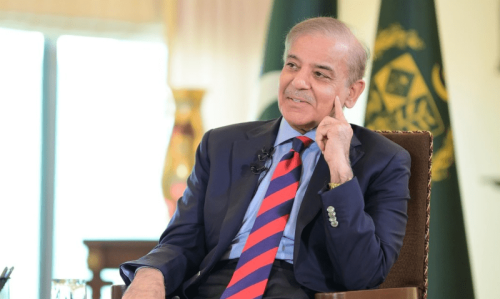
ISLAMABAD: PTI founder Imran Khan on Wednesday brought his legal battle against a Rs10 billion defamation lawsuit, filed by Prime Minister Shehbaz Sharif, to the Supreme Court.
The petition challenges a lower court’s procedural handling of the case, which has been pending since 2017.
The lawsuit was originally filed by PM Shehbaz, then the chief minister of Punjab, after Khan alleged in a television interview that he was offered a Rs10bn bribe.
Mr Khan claimed the offer was made on behalf of PM Shehbaz and his family to persuade him to drop the Panama Papers case against ex-PM Nawaz Sharif.
In a petition moved by Advocate Mian Mohammad Hussain, Mr Khan has asked the Supreme Court to set aside a May 8 decision by a single-judge bench of the Lahore High Court (LHC).
The petition argues that the then-chief minister filed the suit under Sections 4 and 9 of the Defamation Ordinance 2002 before the District Judge Lahore, who lacked the jurisdiction and powers under the law.
The suit was later transferred to the court of the Additional District Judge (ADJ), Lahore, which, according to the petition, also lacked jurisdiction.
The defendant (Imran Khan) has already filed his written statement and the case is currently fixed for the plaintiff’s evidence without the framing of issues, the petition states.
During the pendency of the suit, Mr Khan filed an application under Order IV-A, XIV Rule 1(5) read with Section 26-B and 151 of the Civil Procedure Code (CPC) for the framing of issues, as well as an application under Section 26-B(3)(4)(5) read with Order XXVI and Section 151 for the appointment of a commission to record the plaintiff’s evidence.
The ADJ Lahore dismissed the application on Feb 22.
Mr Khan then challenged the Feb 22 order before the LHC, but the single bench of the high court rejected his appeal on May 8.
The petition contends that the LHC was bound by the mandatory provisions of law in Section 26-B, Order IV-A and Order XIV, Rule 1(5) of the CPC to frame issues and send the case back for recording of evidence after framing of issues. “The court cannot exercise the mandatory nature powers and jurisdiction as discretionary powers and jurisdiction,” it argues.
It adds that the high court “misread the relevant law, rules, order, facts, documents, and evidence on file”, and that the court exercised powers “which were not so vested upon it”.
Published in Dawn, July 3rd, 2025