• Dar warns India against adopting escalation posture, says ‘quid pro quo plus’ response will be ‘new normal’
• Says Pakistan charting forward-looking course as world transforms from unipolar to multipolar
• FO welcomes The Hague court award, calls on New Delhi to resume treaty implementation
ISLAMABAD: Pakistan remains determined to protect its rights and entitlements under the Indus Waters Treaty (IWT) and firmly rejects India’s attempts to weaponise water for its narrow geopolitical objectives, Deputy Prime Minister and Foreign Minister Ishaq Dar said on Monday.
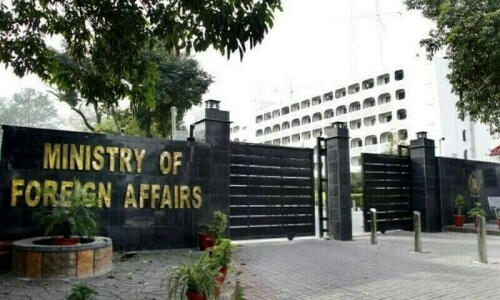
Meanwhile, the Foreign Office also called on India to resume the functioning of the treaty, which it has held in abeyance since May.
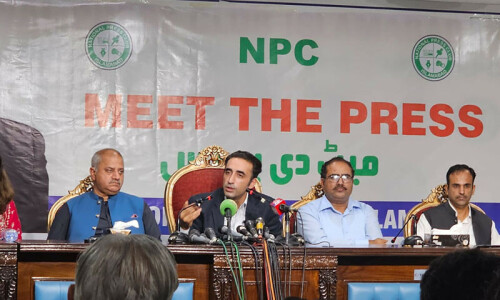
Speaking at the 52nd Foundation Day ceremony of the Institute of Strategic Studies Islamabad (ISSI), Mr Dar said India’s illegal and unilateral action of putting the treaty “in abeyance” has no validity. He further said the mettle of the nation was tested again recently — with India’s unfounded allegations following the Pahalgam attack, and its unprovoked aggression in May 2025.
Islamabad swiftly retaliated to the Delhi’s escalation with a “quid pro quo plus” response — which is the “new normal” set by Pakistan if India insists on its dangerous notion of “limited war under the nuclear threshold”, he said.
‘Hinge moment’
The foreign minister further said Pakistan values the efforts of all friendly countries, including the US, Saudi Arabia, UAE, and Türkiye that resulted in preventing further escalation with India and putting the ceasefire in place.
“Going forward, it is essential to consolidate the ceasefire, institute a reliable crisis management mechanism, and develop confidence-building measures that would help stabilise the regional security situation,” he remarked.
“It is our considered view that sustainable peace in South Asia remains contingent on a just and lasting solution of the Jammu and Kashmir dispute in accordance with the UN Security Council resolutions and the wishes of the Kashmiri people.”
Mr Dar said the world was passing through another “hinge” moment in history. He said the profound transformation was taking place in the world order and the globe was witnessing changes unseen in a century.
The peaceful rise of China, attempts to ‘contain’ China’s rise, resurgence of Russia, increasing salience of Eurasia in global geopolitics, emergence of ‘Middle Powers’, and the growing role of the ‘Global South’ are some of the prominent features of this transitional phase, he remarked.
He said that amidst global turbulence and transformation, from unipolar world to a multipolar one, Pakistan is charting a forward-looking course as a confident and self-assured nation.
Gaza and Iran
He observed that Israel’s genocidal war against Palestinians in Gaza continues to be a stain on the conscience of humanity.
“The wanton killing of children and women, use of starvation as an instrument of war, mass destruction of homes, schools, hospitals and critical infrastructure, and deliberate targeting of humanitarian workers have no parallels in history.”
“These actions are beyond condemnation,” he said.
“We condemned Israel’s completely unjustified aggression against Iran as well as the attack on Iranian nuclear facilities by the US”.
Mr Dar further said these actions, representing a highly dangerous escalation, have been in violation of the UN charter and international law.
He said Islamabad has consistently supported Iran’s legitimate right to self-defence under the Charter. “We appreciate the constructive and pragmatic approach that Iran adopted in finding a negotiated solution to the nuclear issue.”
Positive trajectory
He said that in recent months, Pakistan has purposefully made efforts to reset its relations with Afghanistan on a positive trajectory.
“Among other things, we agreed to upgrade our diplomatic representation to ambassadorial level and extend CPEC to Afghanistan,” he said.
“Having made sincere efforts in Afghanistan’s interest, it is our legitimate expectation that the Afghan interim government would take all steps necessary to ensure that Afghanistan’s soil is not used for terrorism against any state, particularly Pakistan.
India urged to restore IWT
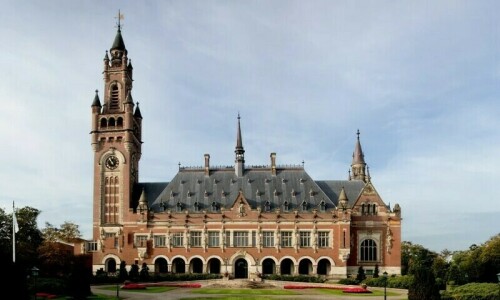
Meanwhile, the Foreign Office (FO) has welcomed the decision by the Permanent Court of Arbitration in The Hague to issue a “supplemental award” on its case over the Indus Waters Treaty.
“In a supplemental award announced on 27 June 2025, the Court of Arbitration hearing the Pakistan-India dispute over Kishenganga and Ratle hydroelectric projects has found that its competence remains intact, and that it has a continuing responsibility to advance these proceedings in a timely, efficient, and fair manner,” the FO said.
“The Court of Arbitration decided to announce this supplemental award in the wake of India’s illegal and unilateral announcement to hold the Indus Waters Treaty in abeyance.”
The FO urged India to “immediately resume the normal functioning of the Indus Waters Treaty, and fulfil its treaty obligations, wholly and faithfully.”
Published in Dawn, July 1st, 2025