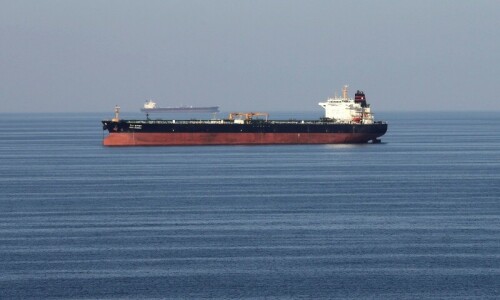
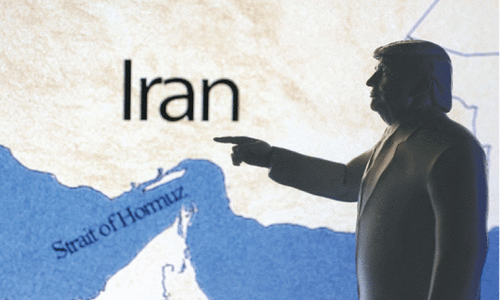
HOUSTON: Vessels near the Strait of Hormuz have been broadcasting unusual messages concerning nationality in a bid to avoid being attacked as doubts linger over the ceasefire between Israel and Iran, according to maritime risk analytics firm Windward and ship tracking data on Thursday.
The signals have been used since conflict broke out between Israel and Iran early this month, which led the U.S. to strike Iranian nuclear sites.
US President Donald Trump brokered a ceasefire after 12 days of war but the maritime threat remains elevated, the Joint Maritime Information Center (JMIC) said.
“The perception among shipowners is that due to the convoluted nature of shipping its hard to know or ascertain clearly a chain of ownership to nationalities which may be under higher threat in shipping, namely the UK, US and Israel,” said Ami Daniel, chief executive officer of Windward.
Fifty-five vessels transmitted 101 atypical messages across the Gulf and Red Sea from June 12-24, Windward said, including “China owned” and “Russian crude”, in the hope of preventing attacks because those countries are less likely to be targeted than Western ships.
Commercial maritime traffic surged 30pc on June 24, the day after the ceasefire, according to the JMIC. Roughly a fifth of the world’s fuel and oil consumption moves through the Strait of Hormuz.
Vessels typically broadcast their destinations or say “For Orders”. Occasionally, vessels also transmit messages such as “Armed Guards on Board” to deter pirates or other attacks.
Unusual messages were almost only seen in the Red Sea before June 12, said Windward’s Daniel. The Red Sea had been the focus of a series of attacks by Houthi rebels since the Israel-Gaza war broke out. “I’ve never seen it in the Persian Gulf,” Daniel said.
Panama-flagged container ship Yuan Xiang Fa Zhan, bound for Pakistan, was broadcasting “PKKHI all Chinese” on Thursday as it crossed the Strait of Hormuz, according to LSEG data.
China-flagged supertanker Yuan Yang Hu was broadcasting “Chinese ship” on Thursday morning while crossing the Strait of Hormuz. Carrying crude oil from Saudi Arabia to China, the signal changed to “CN NBG”, the Chinese Port of Ningbo-Zhoushan, once the vessel had cleared the Strait.
Singapore-flagged container ship Kota Cabar was signalling “Vsl no link Israel” as it sailed through the Red Sea.
JMIC also warned of electronic interference in the region affecting Global Navigation Satellite System (GNSS). A jammed GNSS can cause ships to go off course, increasing the risk of collision with other vessels or obstacles.
Published in Dawn, June 27th, 2025