

When Kazimir Malevich, the Kyiv-born Russian artist created the famous Black Square, he said, “In the year 1913, trying desperately to free art from the dead weight of the real world, I took refuge in the form of the square.” We must view Black Square in the context of the white space around it because Malevich associated Black Square as a new form of spirituality, viewing it as a sacred symbol for a ‘modern’ spirituality.
A hundred and thirteen years later, we know how to create an informed metaphysical dialogue through the paradigms of abstract structures and sub structures because of the Suprematists. Hilma af Klint painted what she referred to as “spiritual messages” at a time when they would have been derided. It speaks to the prescience of the avant garde movement in Russia and the prescience of their thoughtfulness.
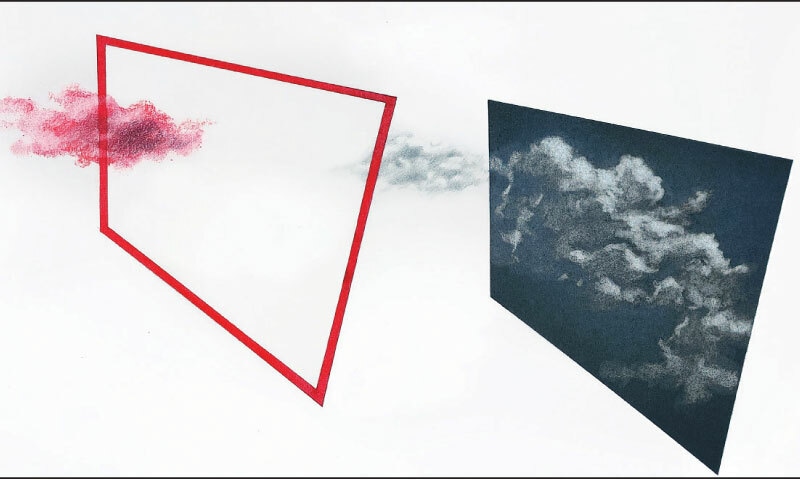
Syed Danish Ahmed’s solo show at Canvas Gallery, titled ‘Original’, is a series of works that manifest the minimalism of form and colour to signify transcendental meaning. The only ‘other’ object in his works are clouds that float through dimensions and cross barriers — sometimes like unruly, unthinking children but mostly contained and orderly, like disciplined workers of a superlative universal commander, doing their duty. The clouds signify His presence, a trope used through centuries of mythology and religious visual representation.
Ahmed’s shapes may be basic quadrilaterals, polygons, hexagons or multi-sided prismatic or varying shapes of mathematical exactitude and faceted forms, but we are left to weigh them. They resemble stark paper cut-outs in striking basic colours, more like origami foldouts. From a distance, against flat white backdrops, they float in space, buoyant and weightless. Close up, they are heavy and dark and infused with the colours of the prism.
Pure form and colour turn into a medium for profound contemplation at a recent exhibition in Karachi
In some works, they gain the weight of mortar and concrete and become walls and portals to different dimensions. All the paradoxes in the works are deliberate and meant to ask questions of the viewer — as all art does, not to cause confusion, but to invite introspection and internal response.
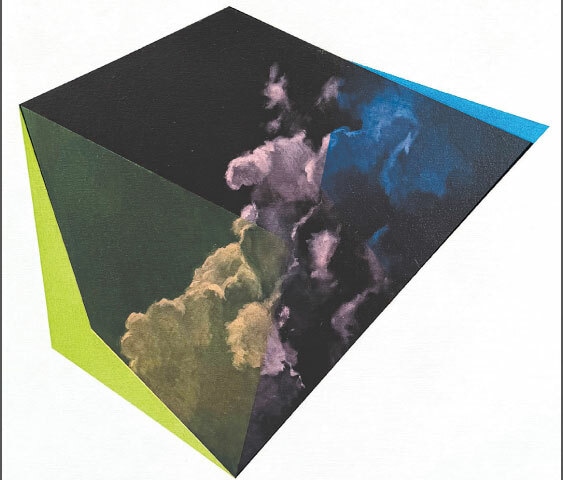
Ahmed has taken it upon himself to use a medium that is rigorous and, in fact, formidably challenging. The precision of the shapes resembles the simplicity of paper cut-outs but are in fact chalk on paper. Chalk is perhaps the least precise medium of the colouring substances and to utilise it for a meticulous and scrupulous result seems like an artist trying his best to fail before he begins. The material success of Ahmed’s works is no mean feat. He takes this challenge and flies with it — he constructs, he folds, he manufactures and he composes a universe that he wants us to re-examine.
There are works where two sets of geometrical shapes appear to lurch towards each other but stop short — a hair’s breadth away from converging. It is in this spatial reality, exactly here, where Ahmed is investigating and unravelling transcendental relationships and asking questions. What lies in the void point between the two forms? What lies in the silence or the nothingness?
Though the Suprematists may have been on to something extraordinary, they did not have the advantage of centuries of the Muslim principle of visual expression, through which we have been long trained to articulate notions of transcendental metaphysics.
The philosopher and theologian Seyyed Hossein Nasr, in his book Islamic Art and Spirituality, says, “The causal relation between the Islamic revelation and Islamic art, is borne out by the organic rapport between this art and Islamic worship, between the contemplation of God as recommended in the Quran and the contemplative nature of this art, between the remembrance of God [dhikrallah], which is the final goal of all Islamic worship, and the role played by Islamic art of both a plastic and sonoral nature in the life of individual Muslims and the community or al-ummah as a whole. This art could not perform such a spiritual function if it were not related in the most intimate manner to both the form and content of the Islamic revelation.”
It is through clarity of purpose, minimalism of form, fundamentals of colour and the paring of all non-essentials in life and thought that Ahmed has found his way to originality.
‘Original’ was on display at Canvas Gallery in
Karachi from June 12-21, 2025
The author is an independent art writer and curator
Published in Dawn, EOS, June 22nd, 2025