If Khamenei falls, what next?


PARIS: Israel increasingly appears eager to oust the clerical leadership that has ruled Iran since the 1979 Islamic revolution, but is taking a gamble given the Iranian opposition is divided and there is no guarantee new rulers would be any less hardline, analysts say.
By striking targets other than nuclear or ballistic facilities, such as Iran’s IRIB broadcaster, expectations have grown that Israel has goals beyond degrading Iranian atomic and missile capabilities and eyes removing supreme leader Ayatollah Ali Khamenei.
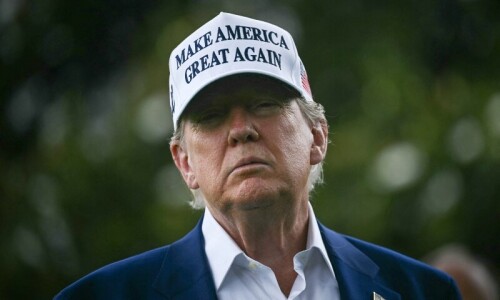
But while President Donald Trump has warned “we know” where Khamenei “is hiding”, what would follow his removal after over three-and-a-half decades in power is shrouded in uncertainty and risk.
European leaders are haunted by the aftermath of the US-led invasion of Iraq in 2003 and the Nato-led intervention in Libya in 2011. They resulted in the removal of dictators Saddam Hussein and Moamer Qadhafi but also in years of bloody mayhem in both countries.
“The biggest mistake today is to seek regime change in Iran through military means because that would lead to chaos,” French President Emmanuel Macron said at the end of the G7 summit in Canada. “Does anyone think that what was done in Iraq in 2003… or what was done in Libya the previous decade was a good idea? No!” Macron said.
Analysts say ousting Khamenei and his fellow clerical leaders risks creating a vacuum that could be filled by hardline elements in the Revolutionary Guards (IRGC) ideological force or the Iranian military.
“Israel’s strikes seem more focused on regime change than non-proliferation,” said Nicole Grajewski, fellow at the Carnegie Endowment.
“Of course Israel is targeting ballistic missile and military related facilities but they are also targeting leadership and symbols of the regime like the IRIB,” she said.
“If the regime were to fall, the hope would be for a liberal and democratic government. “However, there is a strong likelihood that other powerful entities like the IRGC could emerge as the replacement,” she said.
Among the highest-profile opposition figures is the US-based Reza Pahlavi, the son of ousted shah Mohammad Reza Pahlavi. He has declared that the Islamic republic is “on the verge of collapse”, accusing Khamenei of “hiding underground” like a “frightened rat”.
Pahlavi has long called for the restoration of the warm relationship that existed between his late father and Israel.
Published in Dawn, June 20th, 2025