If the numbers are anything to go by, the second budget of the Ali Amin Gandapur government for FY26 focuses on fiscal consolidation, infrastructure development, and provincial tax income growth while seeking to pass on whatever relief it can to its citizens.
That the province, whose economy is massively devastated by decades of militancy, is committed to producing a cash surplus of Rs157 billion, up from more than Rs100bn generated during the current year, as part of a federal requirement to keep down the consolidated national budget deficit under the International Monetary Fund funding programme while significantly raising allocation for development and the salary bill speaks a lot about its efforts to strike a delicate balance between its income and expenditures without breaching fiscal discipline.
The provincial authorities insist that they have been pursuing fiscal consolidation, development, tax reforms and relief in spite of multiple challenges — security conditions that saw funding for law enforcement rise by 27 per cent to Rs150bn next year, drastically reduced, or nil transfers from the centre to Khyber Pakhtunkhwa under the heads of net hydel profits, windfall levy under the 2012 petroleum policy, and greatly slashed federal funds for the erstwhile tribal backyard.
The Rs2.12 trillion provincial budget for the next fiscal year features a record Rs547bn development outlay, a projected cash surplus of Rs157bn, 38pc hike in provincial revenues — this includes a 32pc spike in tax income to Rs83.5bn from the original estimates of Rs63.19bn for the outgoing year — and an increase in pay and pension of the provincial employees in line with the federal announcement.
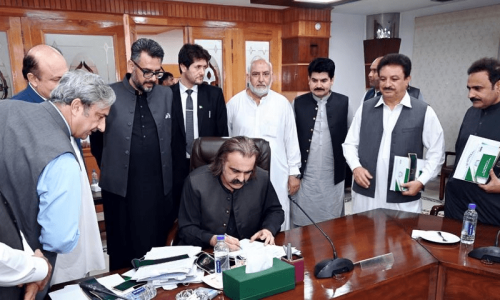
The PTI government also raised the minimum wage to Rs40,000 in stark contrast to the federal and Sindh authorities’ decision to skip this under pressure from the business community. Besides, finance minister Aftab Alam announced a reduction in stamp duty from 2pc to 1pc on the allotment and transfer of residential and commercial properties. The residential and commercial properties up to 4.9 marla will now be exempt from the payment of property tax. The hotel bed tax has also been cut from 10pc to 7pc, while the registration and token taxes for environmentally friendly vehicles will also be waived. He said that no new taxes would be imposed on the merged districts or the former Provincially Administered Tribal Areas.
In his budget speech, Mr Alam pointed out that the budget emphasis is on social protection, employment opportunities, security and economic development. He said reforms are being introduced in services sales tax and property tax, among others, to improve revenue collection. “The government has decided to improve the tax net instead of increasing the taxes,” he said. “The new budget is not just a budget document. Rather, it is a roadmap for the development and prosperity of the province and reflects the government’s resolve to strengthen the economy and people of the province,” he added.
The estimate of the budgeted provincial receipts of Rs2.12tr appears a bit on the ‘higher side’, as some of the revenues, like the sum of over Rs105bn booked on account of net hydel profits and Rs58.1bn under windfall levy on oil, and federal funds for the merged districts of ex-Federally Administered Tribal Areas, may not materialise — fully or partially. Yet the province has shown that it achieved its development and cash surplus targets this year despite reduced transfers from the centre, which gives hope that it would pull off its budget next year as well.
Federal receipts remain the province’s main revenue source, totalling Rs 1.506 Rs1.506tr. This includes Rs1.147tr from the federal divisible pool, Rs137.9bn under the one per cent share for the war on terror, Rs57.11bn in straight transfers, Rs58.15bn in windfall levy on oil, Rs34.5bn in net hydel profit (NHP) and Rs71.4bn in NHP arrears. The province’s own tax and non-tax revenues are projected at Rs129bn, comprising Rs83.5bn in tax revenue and Rs45.5bn in non-tax revenue. Other receipts are estimated at Rs10.25bn.
Revenue estimates for the merged tribal areas have been set at Rs292.3bn, including Rs80bn as a current budgetary grant, Rs63bn in additional demand, Rs39bn under the Annual Development Programme, Rs50bn through the Accelerated Implementation Programme, and Rs17bn for the rehabilitation of temporarily displaced persons.
KP has also projected Rs42.7bn under its 3pc share from other provinces for merged areas — a head under which it hasn’t received a single paisa so far since no other province agreed to the proposal when the National Finance Commission had met last time back in 2021.
The budget strategy paper 2025-28 says the economic review of KP presents an optimistic outlook for the province, highlighting a modest economic recovery among persistent challenges. Khyber Pakhtunkhwa’s economy recovered from near stagnation in FY23 (0.08pc growth) to a growth rate of 2.16pc in FY24, signalling resilience in the face of inflationary pressure and global uncertainties.
The provincial GDP reached Rs4.2bn, with nominal per capita GDP improving to Rs257,159. The commodity-producing sectors, agriculture and industry, collectively contributed over 51pc of the GDP.
Key development indicators show gradual improvements: literacy rose to 55.1pc, immunisation coverage reached 90pc, and the Sehat Card Plus ensured health access for over 30 million individuals. Nevertheless, education access gaps, rising maternal mortality and urban-rural disparities remain pressing issues, it admits.
Published in Dawn, The Business and Finance Weekly, June 16th, 2025