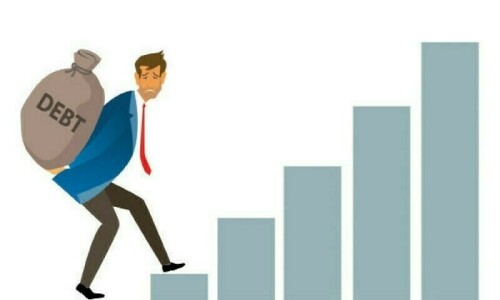
ISLAMABAD: The total debt of Pakistan stood at Rs76.01 trillion at the end of March this year, with domestic debt at Rs51.52tr and external debt at Rs24.49tr, according to the Pakistan Economic Survey 2024-25 released on Monday.
Growth in public debt was 6.7 per cent, which was lower as compared to the growth of 7.4pc in the same period of the preceding year, mainly due to increased primary surplus.
Moreover, total markup expenditure during 9MFY25 amounted to Rs6.44tr, representing 66pc of the full-year budget estimate of Rs9.78tr. The majority of this expenditure was on domestic debt, which accounted for Rs5.78bn or 66pc of the annual allocation of Rs8.74tr, whereas interest payments on external debt reached Rs656bn, equivalent to 63pc of the budgeted Rs1.04tr.
The steady execution of the interest expense budget over the first three quarters highlights the effective cash flow planning and debt servicing discipline. It also underscores the impact of ongoing efforts to lengthen debt maturities, as a shift toward longer-term instruments gradually moderates short-term repayment pressures.
External public debt was recorded at $87.4bn at end-March 2025, revealing an increase of around $883 million during 9MFY25 compared to an increase of $2.6bn during the same period of the last fiscal year.
Pakistan’s total external public debt consists of two components: government external debt and debt obtained from the International Monetary Fund (IMF). Government external debt accounts for the majority, amounting to $79.13m, while debt from the IMF stands at $8.23m. The IMF debt further consists of the federal government debt ($3.88m) and the central bank debt ($4.39m).
The survey states that Pakistan’s external public debt portfolio reflects a strategic approach emphasising long-term, concessional loans primarily sourced from multilateral and bilateral partners. This prudent strategy has mitigated immediate repayment pressures.
There was an increase of Rs4.8tr in the domestic debt of Rs51.5tr during 9MFY25. The growth was largely driven by higher mobilisation through long-term instruments, while short-term and other components saw a decline.
Published in Dawn, June 10th, 2025